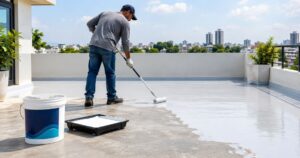
Best Exterior Wall Paint for House 2026: Top Picks
Choosing the best exterior wall paint for house projects in 2026 comes down to matching the coating type to your wall's real problems — humidity, cracks, bare plaster, or a tight budget — not picking whichever tin looks glossiest in the shop.
- Weatherproof exterior emulsion is the best overall exterior wall paint for house exteriors in most Indian climates in 2026.
- Elastomeric coating wins for coastal and high-humidity homes because it stretches over hairline cracks instead of splitting.
- Cement-based exterior paint is the best budget option but needs more frequent recoating than emulsion systems.
- New construction with bare plaster needs a dedicated primer and topcoat system, not paint applied straight onto the wall.
- Textured finishes hide uneven plaster on accent walls but are harder to touch up later.
Why this matters
Exterior walls in India take a harder beating than interiors — direct sun, monsoon spray, and dust in the same 12 months. Picking the wrong category of paint means repainting in 18 months instead of getting a full paint cycle out of the job. MRF Paints makes exterior emulsions, primers and specialty coatings for exactly this range of wall conditions, and the category you choose matters more than the shade you pick.
Pricing for exterior paint varies by finish, pack size and brand, so confirm current rates with your dealer before you order enough to cover the whole house — this guide focuses on which paint type solves which wall problem, not on cost.
What makes the best exterior wall paint for house exteriors
- Weather resistance — how well the film holds up against monsoon rain, UV exposure and temperature swings across summer and winter
- Crack-bridging ability — whether the coating can stretch over hairline cracks in plaster without splitting
- Breathability — letting trapped moisture in the wall escape instead of blistering the paint film
- Finish and sheen — matte, satin or textured, and how each hides or highlights surface imperfections
- Ease of application and recoat time — how forgiving the paint is for a painter working across a full elevation
- Fit for your wall's actual condition — new plaster, old repainted walls, or walls with visible cracks all need different starting points
At a glance
| Paint type | Best for | Standout feature | Key limitation |
|---|---|---|---|
| Weatherproof Exterior Emulsion | Most homes, general use | Balances weather resistance with a clean finish | Not built to bridge wide cracks on its own |
| Elastomeric Exterior Coating | Coastal and high-humidity regions | Stretches over hairline cracks and movement | Thicker film, longer dry time between coats |
| Exterior Primer + Topcoat System | New construction, bare plaster | Seals fresh plaster before colour goes on | Adds a step and a drying window to the job |
| Textured Exterior Finish | Accent walls, uneven plaster | Hides surface imperfections visually | Harder to spot-touch without a visible patch |
| Cement-Based Exterior Paint | Tight budgets | Lowest-cost way to cover a wall | Shorter repaint cycle than emulsion systems |
1. Weatherproof Exterior Emulsion: best exterior wall paint for most Indian homes
Weatherproof exterior emulsion is the standard starting point for houses that don't have specific problems like heavy humidity, wide cracks, or bare new plaster. It's formulated to resist rain and UV while staying breathable enough that trapped wall moisture doesn't blister the film.
Weatherproof exterior emulsion pros:
- Works across most wall conditions without extra prep steps
- Available in a wide range of finishes and sheens
- Straightforward for painters to apply in standard coats
Weatherproof exterior emulsion cons:
- Doesn't bridge cracks wider than hairline movement
- Performance depends heavily on surface prep before the first coat
Best for: homeowners repainting an existing house with no major wall damage.
Verdict: Buy — this is the default pick unless your walls fall into one of the categories below.
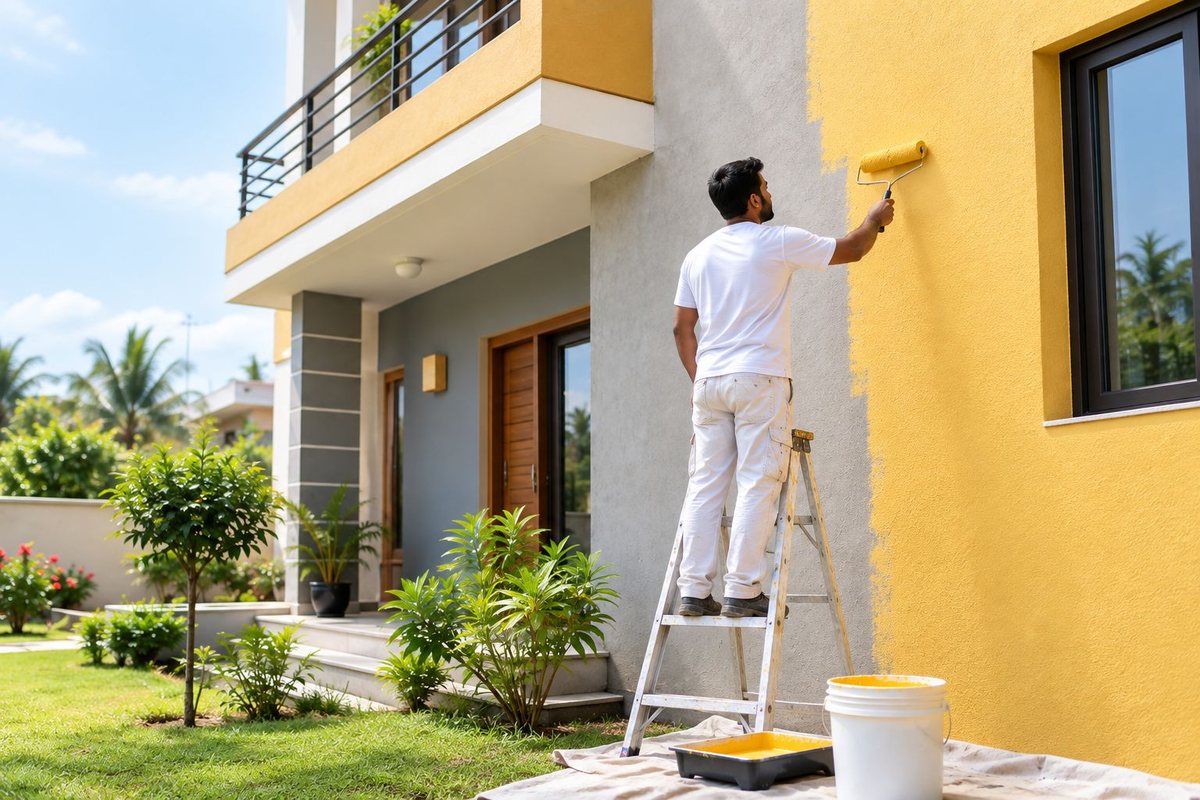
2. Elastomeric Exterior Coating: best exterior wall paint for coastal and high-humidity homes
Elastomeric coatings form a thicker, more flexible film than standard emulsion, which lets them stretch over hairline cracks instead of splitting when the wall moves with heat and moisture. That flexibility is the reason this category shows up so often in coastal towns and homes near water bodies where humidity swings are constant through 2026's monsoon and summer cycle.
Elastomeric coating pros:
- Bridges hairline cracks that standard emulsion would show through
- Handles sustained humidity better than thinner paint films
- Reduces the chance of early blistering in wet climates
Elastomeric coating cons:
- Longer dry time between coats than regular emulsion
- Overkill for dry-climate homes with no crack or humidity issue
Best for: homes in coastal cities or regions with heavy, sustained monsoon exposure.
Verdict: Buy — if your walls show hairline cracking or you're within a few kilometres of the coast, this is worth the extra step.
“If the wall already has hairline cracks, no shade of paint fixes movement — elastomeric coating does.”
3. Exterior Primer + Topcoat System: best exterior wall paint for new construction
Bare plaster is alkaline and porous, and painting straight onto it without a primer is the single most common reason new-build exterior paint fails early. A primer seals the surface and gives the topcoat something consistent to bond to, rather than sinking unevenly into raw plaster.
Primer + topcoat system pros:
- Seals fresh plaster so the topcoat colour goes on evenly
- Reduces patchy absorption across different areas of new walls
- Sets up the topcoat to perform closer to its intended finish
Primer + topcoat system cons:
- Adds a full extra coat and drying window to the schedule
- Not necessary on walls that are already painted and in good condition
Best for: new construction or any wall stripped back to bare plaster.
Verdict: Buy — skipping the primer step on new plaster is the fastest way to see peeling within the first year.
4. Textured Exterior Finish: best exterior wall paint for accent walls and uneven plaster
Textured finishes add a raised or stone-like surface pattern that hides plaster imperfections a flat finish would expose. They're most often used on porch fronts, gate pillars, or a single accent elevation rather than an entire house exterior.
Textured finish pros:
- Hides minor plaster unevenness that flat emulsion would show
- Adds visual depth on porches, pillars and feature walls
- Works well combined with a flat weatherproof emulsion elsewhere on the house
Textured finish cons:
- Harder to spot-repair without a visible patch
- Not practical to apply across a full house exterior
Best for: accent walls, gate pillars, or porch fronts with uneven plaster.
Verdict: Hold — use it selectively on feature sections, not as your main exterior coating.
5. Cement-Based Exterior Paint: best budget exterior wall paint
Cement-based paint is the lowest-cost way to put a protective, coloured layer on an exterior wall, and it's still common on outbuildings, boundary walls, and budget-first projects across India in 2026. It won't match the weather resistance or life of an emulsion or elastomeric system, but it does the basic job of covering and protecting plaster.
Cement-based paint pros:
- Lowest upfront cost per wall covered
- Simple to apply, forgiving for basic DIY jobs
- Adequate for boundary walls and low-visibility structures
Cement-based paint cons:
- Shorter repaint cycle than emulsion or elastomeric systems
- Weaker crack-bridging and weather resistance overall
Best for: boundary walls, outbuildings, and strictly budget-driven projects.
Verdict: Wait — fine for secondary structures, but reconsider for the main house facade if the budget stretches at all.
How we ranked
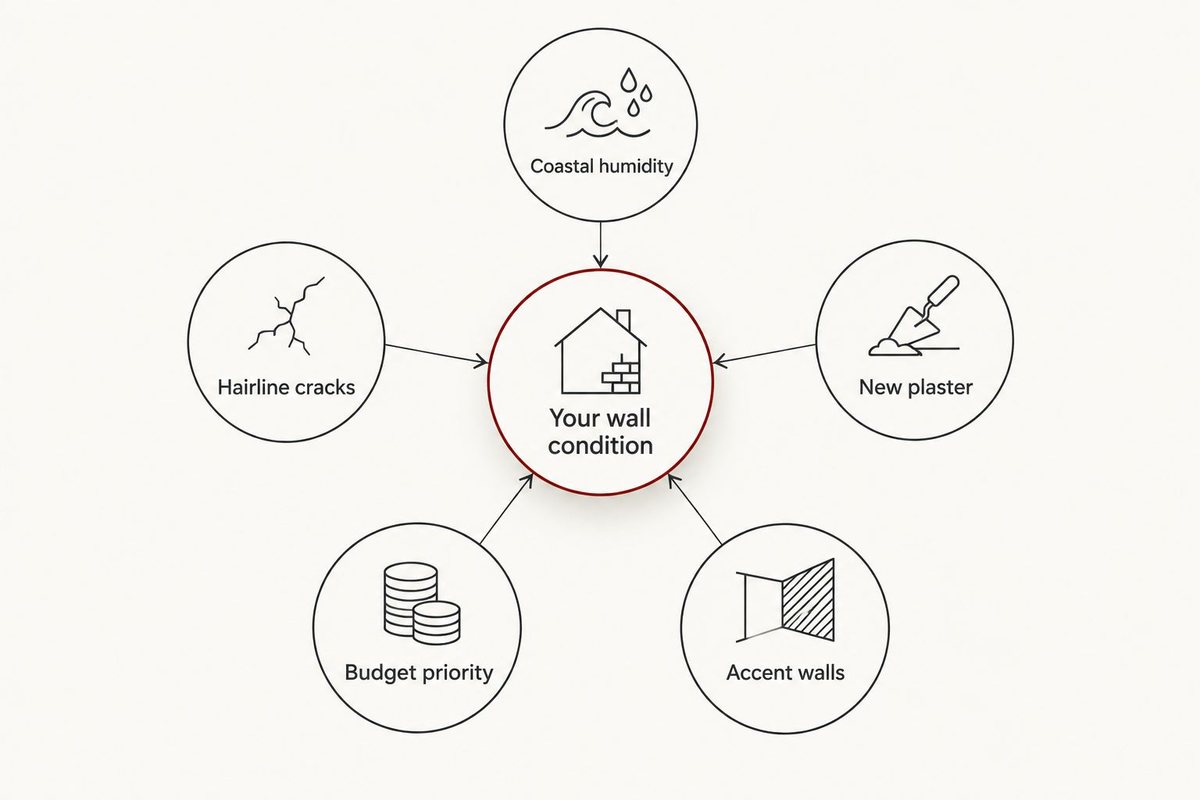
Each category above is ranked by the wall condition it solves best, not by which one is glossiest in a showroom sample. Weather resistance, crack-bridging ability, breathability, finish quality, ease of application and fit for the wall's actual state — bare plaster, existing paint, cracks, or a tight budget — decided the order and the "best for" label on every entry.
Which exterior wall paint should you choose?
If you're not sure which category fits, start with weatherproof exterior emulsion — it covers the largest share of Indian homes without special conditions. Switch to elastomeric coating the moment you see hairline cracks or your home sits in a coastal or consistently humid region. New construction always needs the primer and topcoat system regardless of which topcoat category you land on afterward, and a tight budget for a boundary wall is the one case where cement-based paint is a reasonable trade-off rather than a compromise.
Explore MRF Paints’ exterior range
Browse exterior emulsions, primers and coatings before you plan your 2026 repaint.
MRF Paints exterior wall paints
- Most homes, and coastal or humid areas: AquaFresh Exterior, a water-based polyurethane exterior paint with a flexible, stretchable film that resists algae and fungus. About 65-75 sq ft per litre for two coats; 8-year warranty; 1,015 shades.
- One system inside and out: Altura 2-in-1, a water-based acrylic emulsion for exterior and interior walls in matte or sheen. About 60-70 sq ft per litre for two coats outdoors; 6-year warranty plus 3 years against algae and fungus.
- Budget: Campus or the high-sheen Campus Shine, water-based exterior emulsions with a 4-year warranty. About 55-65 sq ft per litre for two coats.
- Walls with hairline cracks: AquaFresh DampGarde, a fibre-reinforced waterproofing system that bridges cracks up to 0.5 mm.
- New plaster: prime first with AquaFresh PU Wall Primer under AquaFresh, Altura 2-in-1 Primer under Altura, or Sello 2-in-1 under Campus, after the plaster has cured for 30 days.
For region-by-region advice, see our guide to the best exterior paint for each Indian climate.
FAQ
What’s the best exterior wall paint for house exteriors in 2026?
Weatherproof exterior emulsion is the best overall choice for most Indian homes in 2026 because it balances weather resistance with a clean finish across a range of wall conditions. Homes with hairline cracks or heavy humidity should move to an elastomeric coating instead.
Is elastomeric paint better than regular exterior emulsion?
Elastomeric paint is better specifically for walls with hairline cracks or sustained humidity, since its thicker film stretches instead of splitting. For a crack-free wall in a dry climate, standard weatherproof emulsion performs the same job for less effort.
Can I paint exterior walls during monsoon?
Avoid it where you can. MRF recommends painting between 20 and 40 degrees C with humidity below 75 percent, on a wall that is dry, so heavy monsoon weeks are a poor time for exterior work. Plan the job for a dry spell before or after the rains.
Do I need a primer before exterior paint?
Yes, a primer is necessary on bare or new plaster because it seals the porous, alkaline surface before the topcoat goes on. Walls that are already painted and in good condition can often skip a fresh primer coat.
What’s the difference between textured and smooth exterior finishes?
Textured finishes add a raised surface pattern that hides plaster imperfections, while smooth finishes show the wall surface more directly. Textured finishes work best on accent walls or pillars rather than a full house exterior.
How much exterior paint do I need for a house?
Divide the wall area by the coverage for two coats. For MRF exterior emulsions that is about 65-75 sq ft per litre for AquaFresh Exterior, 60-70 for Altura 2-in-1 and 55-65 for Campus, so a 1,000 sq ft exterior needs roughly 13-18 litres of emulsion, plus primer on new walls.
Is cement paint good enough for exterior walls?
Cement-based paint is adequate for boundary walls and outbuildings where budget is the main constraint, but it has a shorter repaint cycle than emulsion or elastomeric systems. For a main house facade, weatherproof emulsion or elastomeric coating holds up longer.
Do I need different paint for old versus new construction?
New construction needs a primer and topcoat system to seal bare plaster, while older, previously painted walls can usually go straight to a weatherproof or elastomeric topcoat after surface cleaning. Skipping the primer step on new plaster is the most common cause of early peeling.
One last thing
The category decision matters more than the shade card — a homeowner who picks the right paint type for their wall condition in 2026 gets a full paint cycle out of the job, while the wrong category on the right colour still peels early. Walk your exterior elevation before you buy anything and note where cracks, dampness, or bare patches actually are.