11 Main Iron Gate Colour Combinations for Indian Homes | MRF Paints
The most practical main gate colours for Indian homes are charcoal grey, matt black, deep brown and bronze: they hide dust, water marks and minor rust and suit almost any wall colour. Popular two-tone combinations are charcoal grey with warm white, deep blue with brushed gold, forest green with near black, and navy with off-white. Keep the gate two to three shades darker than the compound wall, and use no more than two colours on the gate. For a finish that lasts, sand off loose rust, apply one coat of Epidec RTC (rust-tolerant) primer, then two coats of a polyurethane topcoat such as MetalCoat, MC+ or Durothane. PU finishes typically last up to 8 years, synthetic enamel 3 to 4.
Your main gate is the first thing people see when they arrive at your home. It sets the tone before anyone notices the balcony, the balcony plants, or the name board. In 2026, homeowners are moving away from plain, single-shade gates and choosing thoughtful color combinations that match their architecture, lifestyle, and the neighborhood vibe.
The right iron gate colors can
- Frame the facade beautifully.
- Make compact frontage look more premium.
- Reduce the look of dust and stains.
- Support better resale appeal.
Below are 11 stunning color combination for main gates in 2026, along with suggested shades so that you can take these ideas straight to your painter or contractor.
Let’s Begin
Most of us repaint our interiors every few years, but the main iron gate quietly carries on with the same old color. It faces sun, rain, dust, traffic and curious glances all day, yet is usually painted in a hurry with “whatever is available” or a leftover wall shade. Over time, the color fades, touch-ups look patchy, and the gate stops matching the home you have carefully upgraded inside.
Choosing that combination is not just about picking a “nice” color. For Indian homes, you also need to think about dust from the road, direction of sunlight, nearby trees, type of tiles or stone at the entrance and how much time you can realistically spend on maintenance. A thoughtful pair of shades can work with all these conditions.
This blog brings you 11 main iron gate color combination ideas curated for 2026, with clear examples of when each one works best, so that you can move from shortlisting on screen to an exact paint choice on site without guesswork.
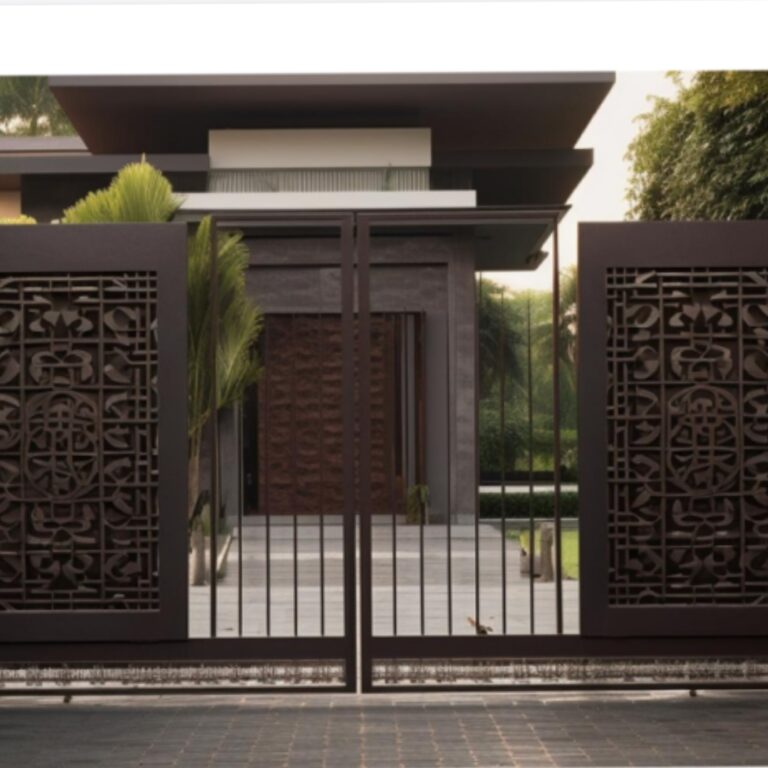
Things To Keep In Mind Before You Pick A Gate Color
Before you fall in love with a combination on Pinterest or Instagram, pause and check:
- Architecture style
Modern homes sit well with greys, charcoal, deep blues and clean neutrals. More traditional or heritage façades suit greens, browns, maroons and metallic highlights. - Direction and climate
South- and west-facing gates receive more sunlight and tend to fade faster. Coastal locations pick up more salt deposits. Deeper colors with good UV resistance work better here. - Maintenance level
If your gate faces a main road, darker mid-tones and slightly textured finishes disguise dust better than flat white or very pale colors.
Once you have this context, you can pick a combination that looks beautiful on day one and remains practically all year.
11 Stunning Color Combinations for Main Gates In 2026
1. Charcoal grey and warm white for a clean, modern look
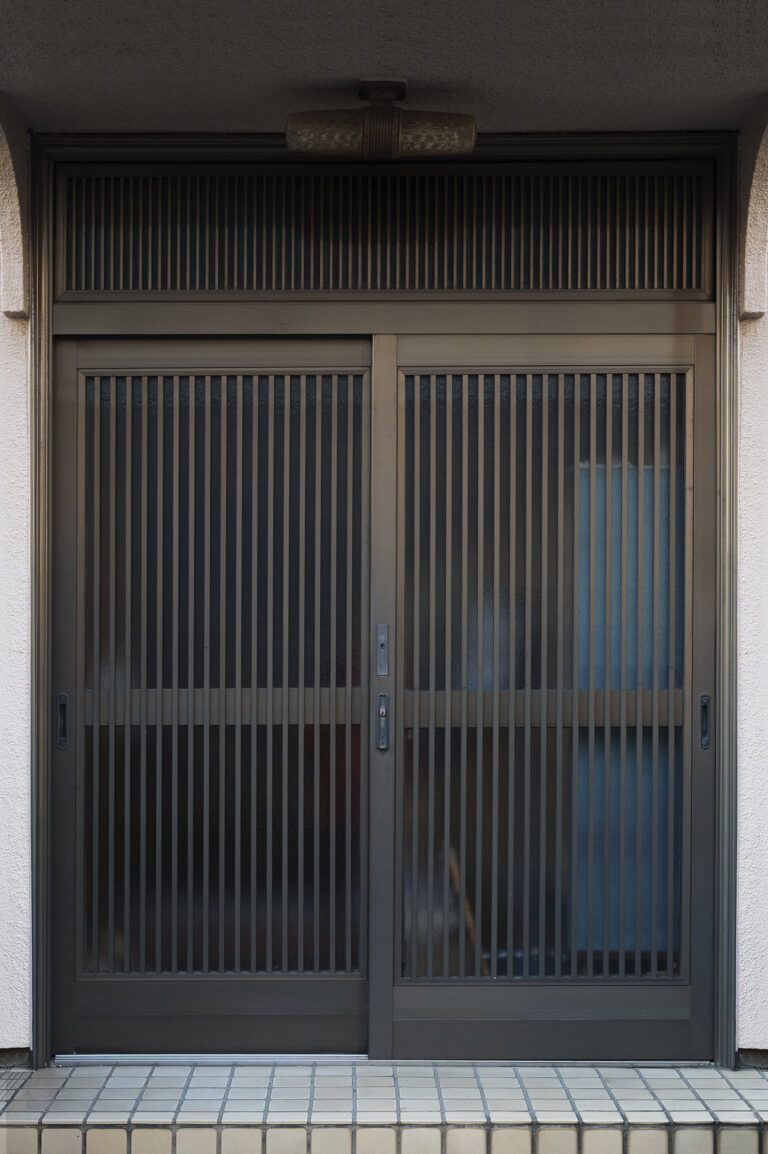
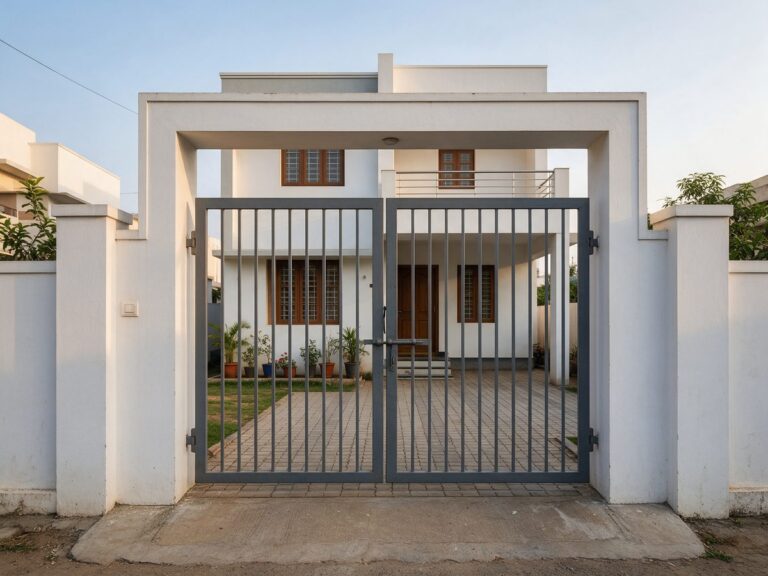
Charcoal and warm white work beautifully in today’s apartments and independent houses, with simple lines and straight grilles. The darker tone hides everyday dust from the main road, while the lighter highlights keep the entrance looking bright and neat. This combination suits painted compound walls, simple tiles and even granite cladding, so it blends well in most Indian streets.
Why it works in 2026
- Grey keeps the design sophisticated without feeling too harsh.
- Warm white highlights make the gate stand out in photos and in low light.
- The contrast stays sharp even after some dust settles.
It looks especially good against off-white or very pale grey compound walls, and pairs beautifully with potted greens at the entrance.
2. Deep blue and brushed gold for quiet luxury
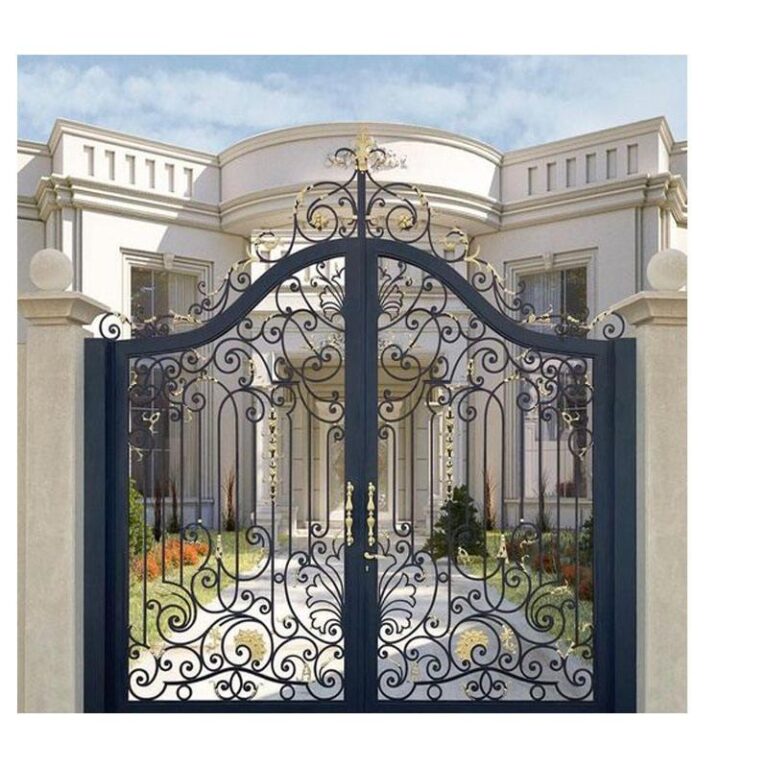
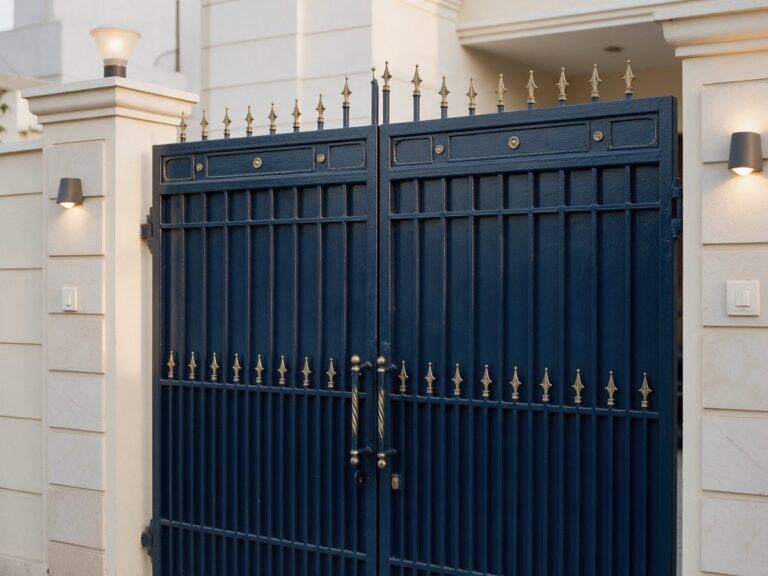
Deep blue with soft gold detailing is a good choice if you want your gate to look rich without being flashy. In the daytime, the blue feels solid and dignified; at night, the gold picks up the glow from gate lights and streetlamps. This pairing works well for larger family homes where the gate needs to look premium from the outside and still match traditional wooden doors or metal railings.
Why it works in 2026
- Dark blues feel rich and grow up while still being welcoming.
- Gold detailing catches sunlight during the day and warm light at night.
- The combination suits both modern and slightly classical homes.
This pairing looks stunning with cream facades, stone cladding and warm outdoor lights.
3. Forest green and near black for a heritage feel
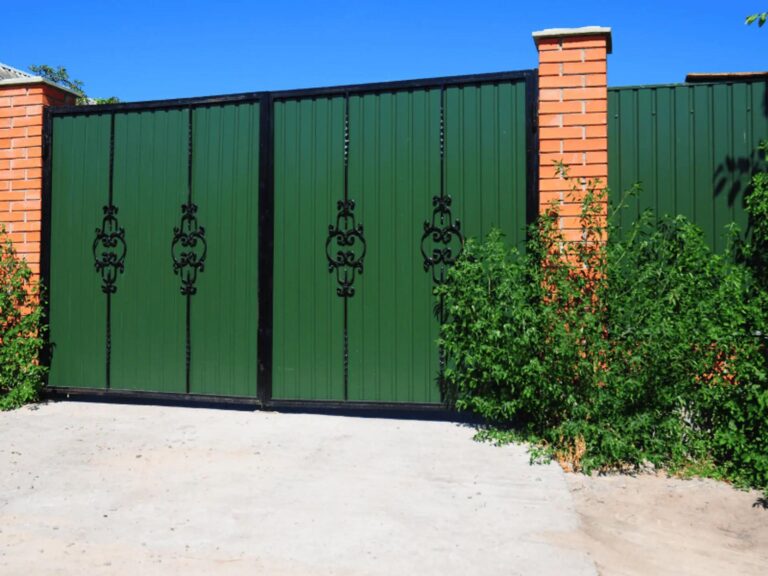
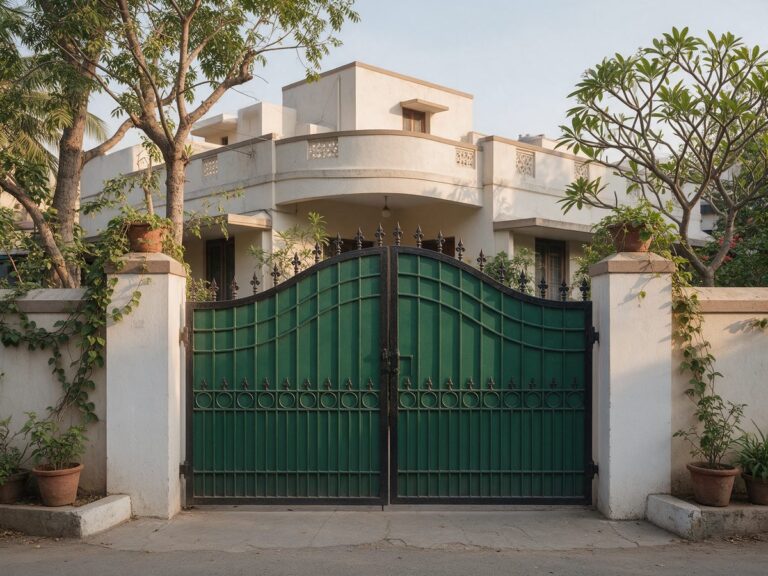
Forest green with a near-black outline is ideal for older houses, corner plots, and homes with trees or garden space in front. The green sits naturally against plants, lawns and roadside avenue trees, so the gate never looks too harsh. The darker frame gives a neat border to the design and helps the gate look solid and secure from the street.
Why it works in 2026
- Green connects visually with plants, lawns and roadside trees.
- Near black frames the gate neatly without looking flat or industrial.
- The palette looks classy with tiled roofs, exposed brick and stone.
Add planters or creepers near the gate to reinforce the garden feel and tie the colors together.
4. Teal and soft grey for a fresh, design-forward entrance
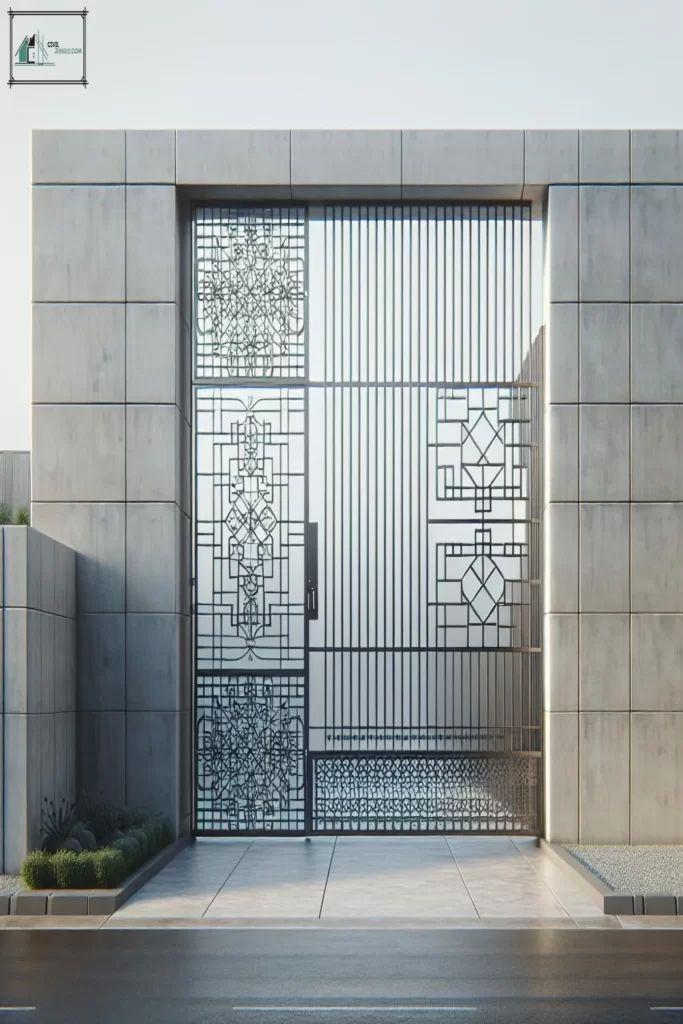
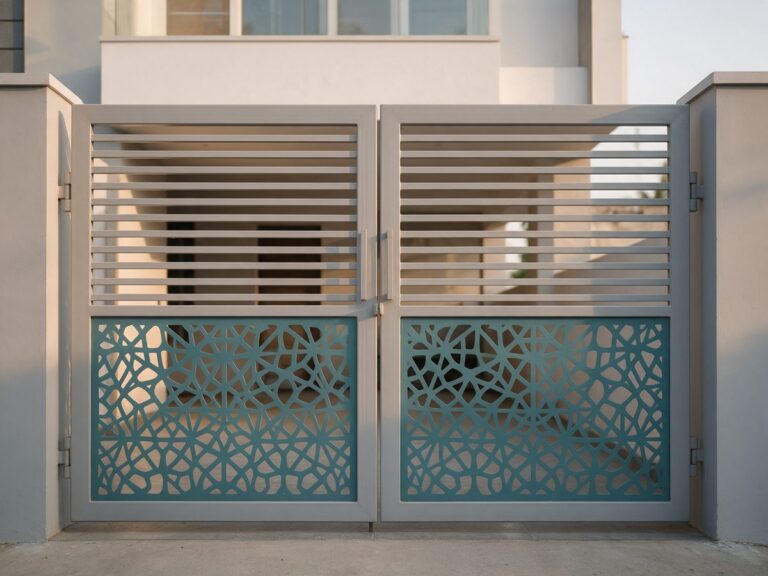
Teal with soft grey is a good option if your home is newly built or has a contemporary elevation with glass, straight grills or Jali work. The teal adds a fresh pop of color that stands out from typical browns and blacks, while grey keeps the overall look calm and balanced. This works especially well in gated communities where many houses look similar, and you still want a subtle point of difference.
Why it works in 2026
- Teal feels more unique than standard green or blue.
- Soft grey balances the brightness and adds maturity.
- The palette works beautifully with white walls, concrete textures and minimalist landscapes.
If your home leans slightly coastal or resort-style, this combination fits perfectly.
5. Rust and coffee brown for an industrial, earthy statement
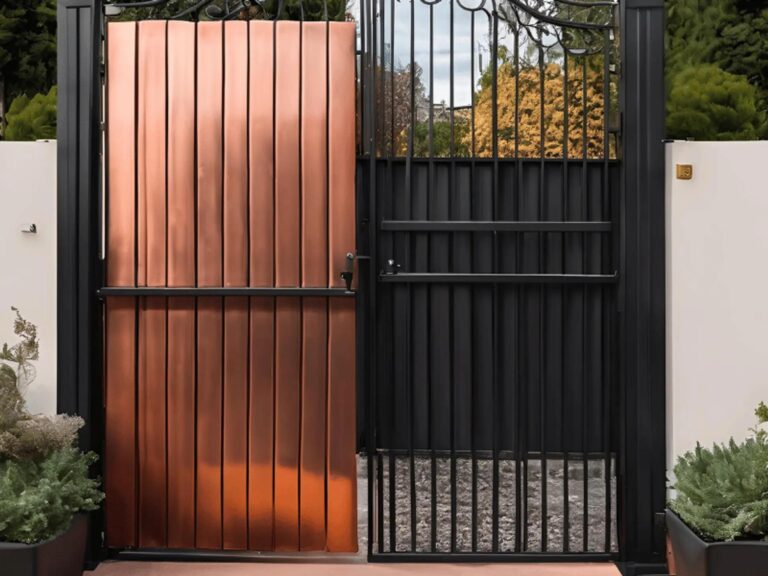
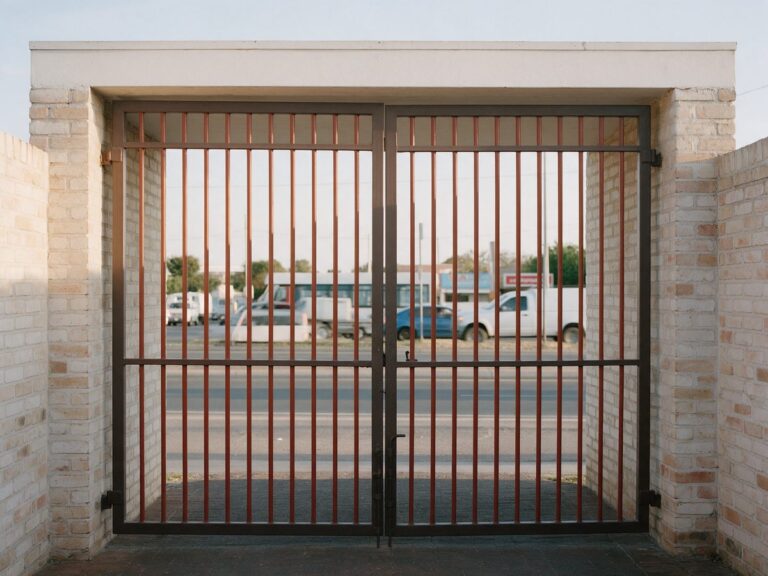
Rust and deep brown suit homes that face busy roads, commercial stretches or areas with more dust and traffic. The earthy tones hide small scratches, hand marks and mud splashes better than very light colors. This combination pairs nicely with brickwork, stone cladding, and darker floor tiles often used outside Indian homes.
Why it works in 2026
- Earthy rust tones are on trend in architecture and landscaping.
- Brown grounds the palette and keeps it from feeling too loud.
- The combination hides dust and minor scratches effectively.
This works well on streets with a lot of traffic or construction dust, where white or very dark colors would be tough to maintain.
6. White and wood-inspired brown for a classic villa façade
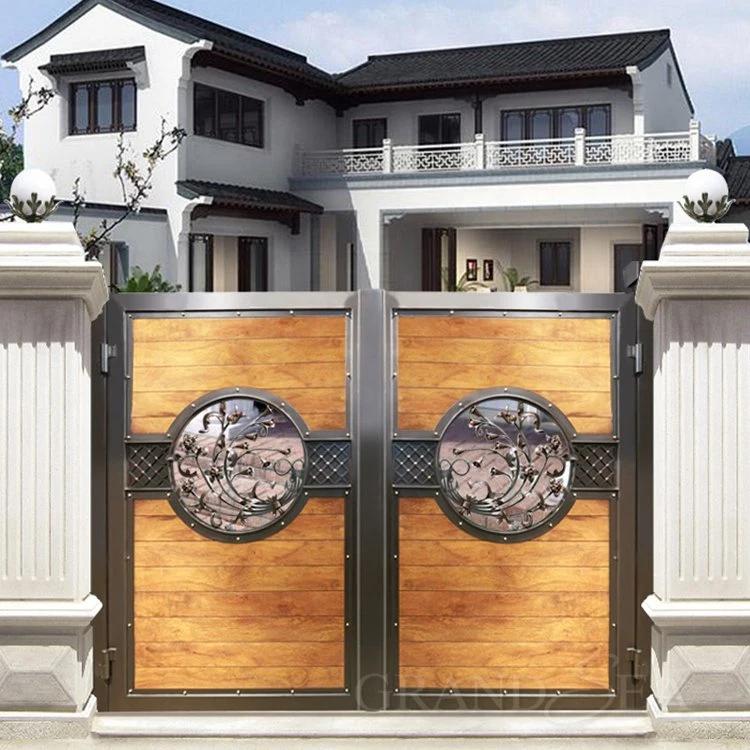
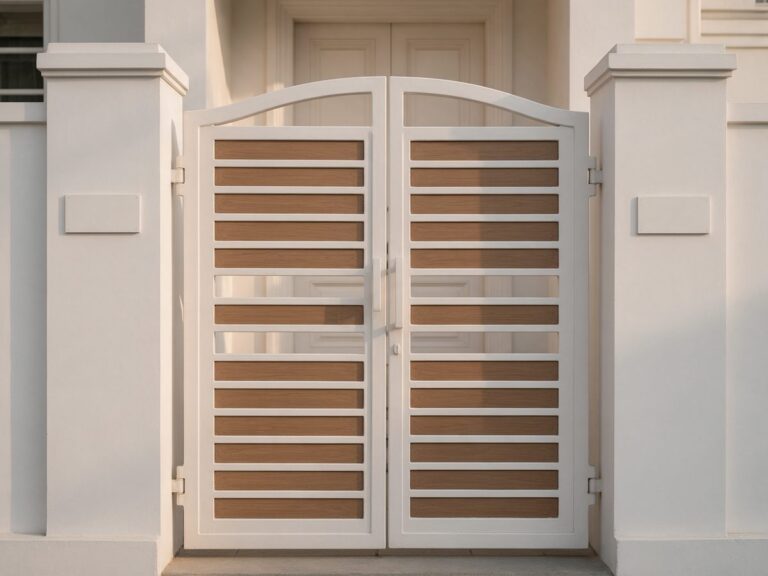
Soft white with a wood-inspired brown works well for homes that already have wooden main doors, balcony railings or window frames. The white keeps the frontage looking bright and welcoming, especially in narrower streets, while the wood tone adds warmth without the upkeep of real timber. This is a safe choice if you host guests often and want the entrance to look tidy in photos and in person.
Why it works in 2026
- White keeps the entrance bright and airy.
- Wood tones give a sense of warmth and homeliness without real timber maintenance.
- The look pairs well with balconies, pergolas and tiled roofs.
Perfect if you are going for a European villa or premium township vibe.
7. Olive green and beige for a calm, nature-inspired gate
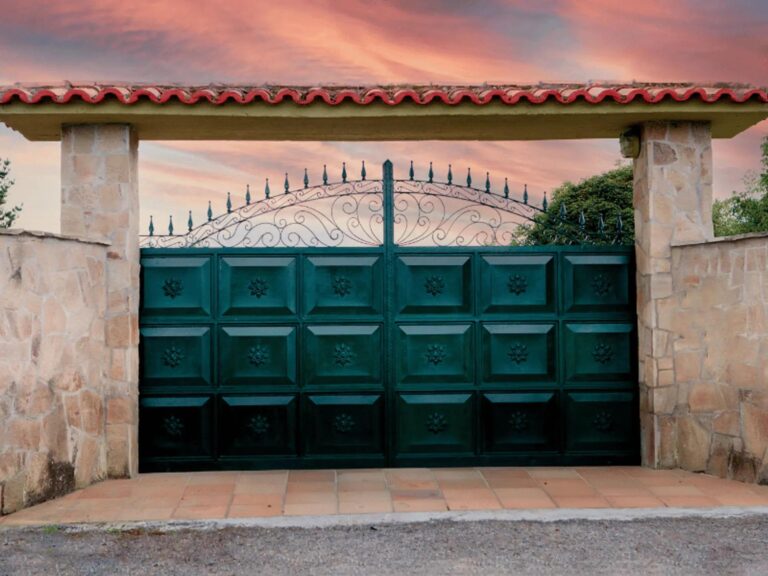
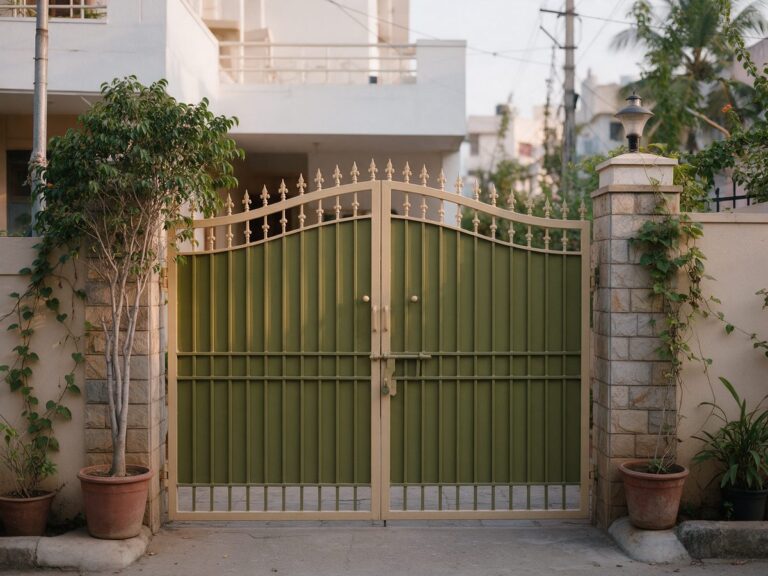
Olive green with beige detailing is a gentle, nature-friendly palette that suits homes with plants, creepers and potted trees near the entrance. The colors blend nicely with both painted compound walls and stone pillars, so the gate doesn’t fight for attention. It is a good option for residential layouts where you prefer a softer, more peaceful look from the road.
Why it works in 2026
- Olive is trending as a sophisticated alternative to bright green.
- Beige softens the palette and blends with stone, tiles and neutral façade.s
- The combination feels grounded and works across seasons.
Add a simple nameplate and warm white gate lights to complete the look without clutter.
8. Graphite grey and silver for sleek, high-rise entrances
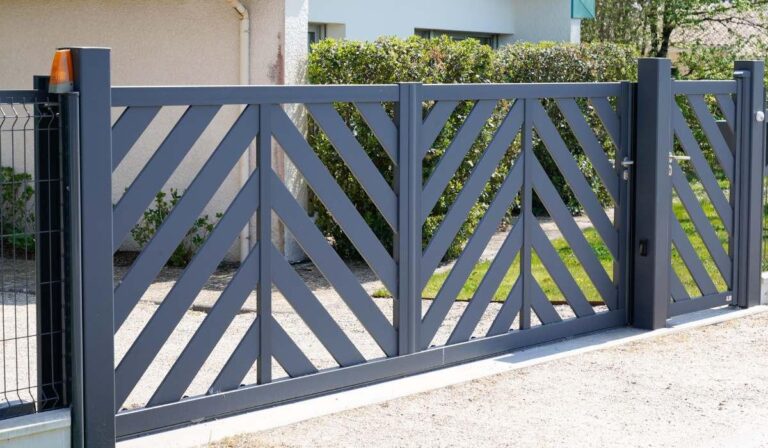
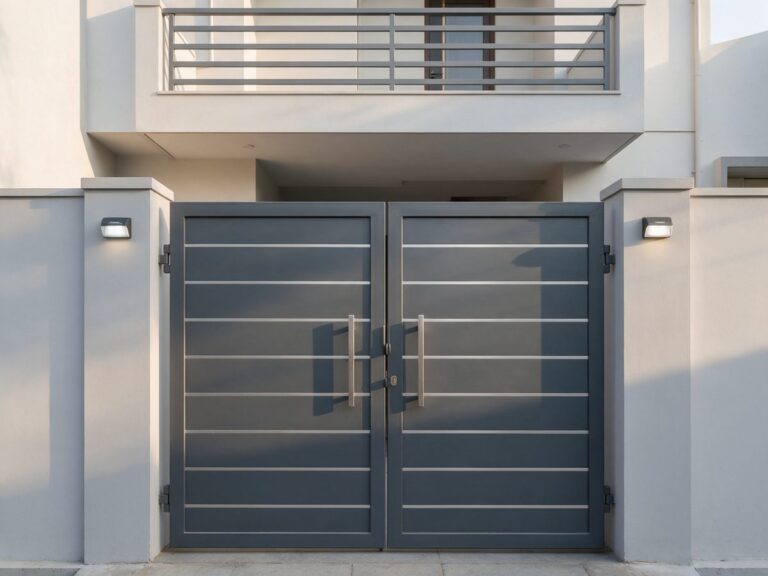
Graphite grey and silver work very well for compact plots, duplex houses and builder floors where the front space is limited. The darker grey makes the gate look sturdy, while the silver lines and handles add a clean, finished touch that shows up nicely under LED gate lights. This combination also matches easily with standard balcony rail shades and window grills used in many Indian projects.
Why it works in 2026
- Metallic-inspired palettes echo modern cars, fixtures and railings.
- Grey hides day-to-day dust better than pure black.
- Silver highlights add just enough sparkle without feeling flashy.
This works very well when your balcony railings, window grills and main door hardware already use similar tones.
9. Brick red and near black for bold street presence
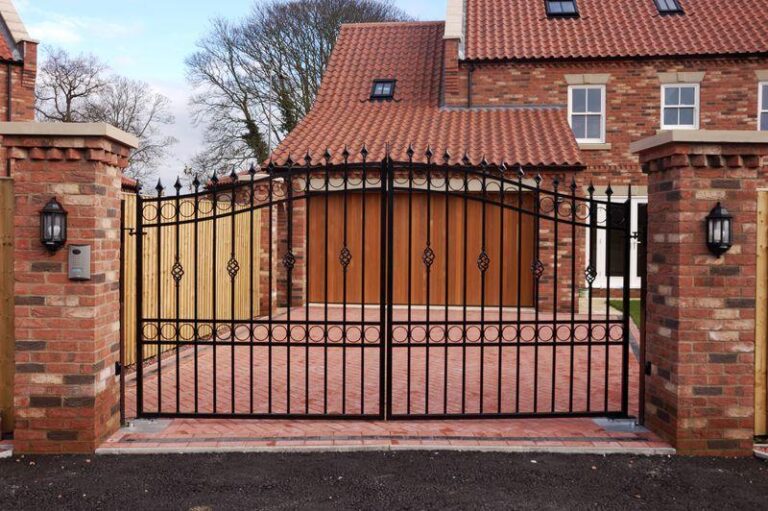
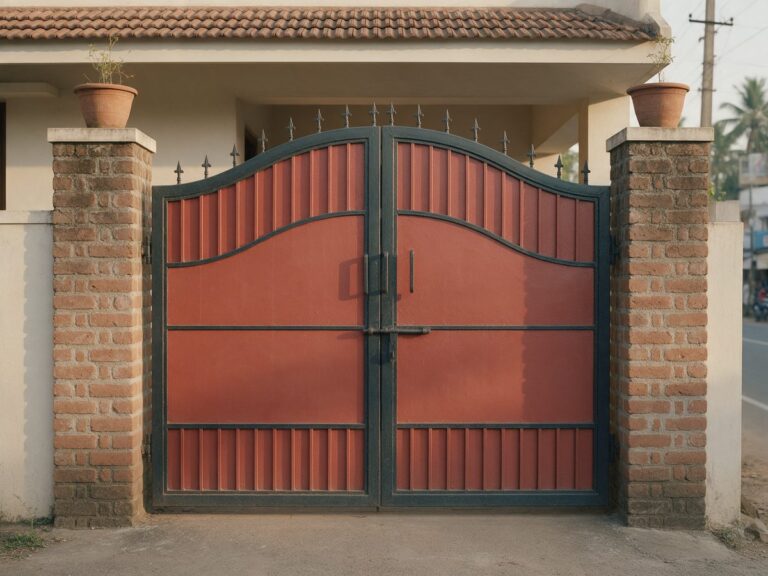
Brick red with near-black detailing gives an intense look that many families prefer for main-road-facing properties. The red complements brick walls, Mangalore tiles, and terracotta pots, while the black outline reinforces a sense of safety. This palette is also practical in areas with frequent vehicle movement, where lighter colors can quickly start to look dirty.
Why it works in 2026
- Brick red hints at traditional materials yet feels bold and urban.
- The dark outline strengthens the silhouette of the gate.
- The palette pairs naturally with brick walls, terracotta tiles and earthy plants.
Add a simple brass nameplate or house number to soften the overall feel.
10. Navy and off-white for a refined, colonial touch
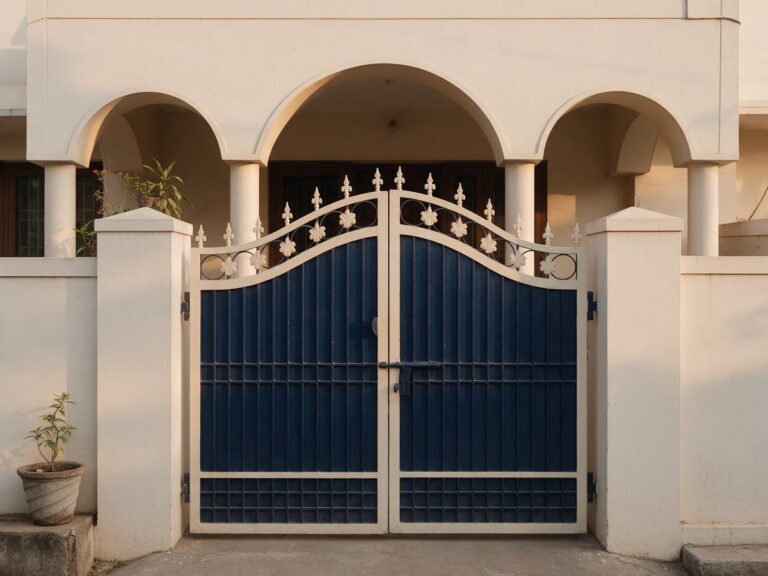
Navy and off-white suit homes with small arches, simple pillars or slightly traditional balcony designs. The navy gives the gate a formal, well-kept look, and the off-white borders or motifs keep it from feeling too heavy. This combination works nicely in older neighborhoods and coastal cities where you want the gate to look bright but still friendly.
Why it works in 2026
- Navy feels distinguished and photographs well at any time of day.
- Off-white detailing looks crisp against both light and dark boundary walls.
- The combination suits coastal cities and older neighborhoods with character.
Pair this with warm outdoor lighting, planters and a simple wooden or solid main door.
11. Layered greys for a subtle, designer gate
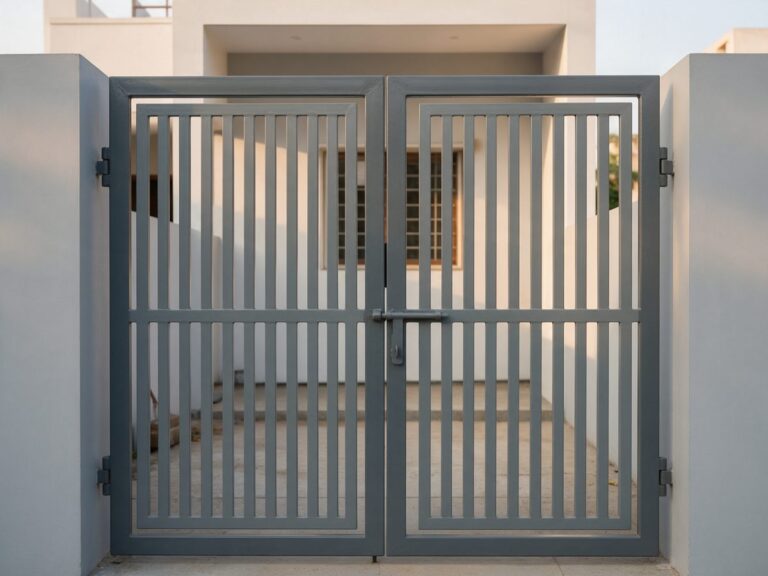
Using two greys from the same family is a good idea if you want a neat, modern gate without too much contrast. A darker grey on the outer frame and a slightly lighter grey on the inside grills give quite depth, especially on compact frontages. It’s easy to maintain, pairs well with almost any exterior wall color, and works well in apartment entrances and independent houses alike.
Why it works in 2026
- Layering tones of one color feels very contemporary
- Greys work across almost any façade color and stone finish
- Small scratches or touch-ups are less noticeable compared to flat black
This is a good option for gated communities with guidelines on façade colors, where you still want your home to look a little more polished.
Stronger Protection for Your Main Gate
MRF Vapocure Paints focuses on making strong, reliable finishes for real Indian homes. Our metal paints for main gates are designed to handle harsh sun, heavy rain, dust and daily movement without giving up easily. With proper surface preparation and priming, they form a tough film that helps protect the iron from rust, peeling and early fading. The surface stays smoother for longer, so regular cleaning and small knocks do not spoil the look quickly. For your main iron gate, this means your chosen color combination can continue to look neat, secure and well cared for through many seasons
Summing Up
Once you have chosen a combination you like, talk to your painter or contractor about:
- Surface preparation for iron gates
- Suitable Primers for exterior metal
- The right topcoat from our systems for weather resistance and gloss or sheen level you prefer
Screens will never show colors exactly as they appear in real life, so always check a physical shade card or a sample panel at the site before finalizing.
Pick the combination that fits your home, your street and your routine, then let a high-quality exterior metal coating do the rest. Your main gate will not only look stunning in 2026, but it will also stand up better to the sun, rain and daily use for years to come.
Questions on Main Iron Gate Colour Combinations?
1. What should I check before deciding on my primary gate colours?
Before you open a shade card, stand outside your house and notice:
- The color of the compound wall and elevation
- The direction your gate faces and how much hard sunlight it receives
- The type of road in front: quiet street, main road, service lane
- Existing window grills, balcony railings and main door finishes
Make a quick note of two or three colors that already dominate the frontage, such as off-white walls with brown grills, or cream walls with grey railings. Your gate combination should either sit in the same family or give a controlled contrast. When you start from what already exists instead of a random reference image, the final result looks more intentional and less like a mismatch.
2. Is it better to choose dark or light colors for an iron gate?
Both can work, but they behave differently in real conditions:
- Darker colors
Hide dust, minor scratches and welding marks better. Suitable for main roads, busy areas and houses near markets or bus routes. - Lighter colors
Make a narrow frontage look more open and airier. Better for internal streets, north-facing homes and plots with less dust.
A practical approach is to keep the main structure in a mid to deep shade and use lighter tones only as accents or borders. This gives you the advantage of easy maintenance without making the gate look heavy.
3. Should my gate match the compound wall and main door?
They do not have to be identical, but they must look like they belong to the same house. You can use these simple rules:
- If the compound wall is light, choose a slightly deeper gate so it stands out neatly.
- If the wall already has stone cladding or tiles, pick a gate shade that appears in those materials or complements them.
- If your main door is wood, having at least one warm tone in the gate (wood-inspired brown, rust, brick red) keeps the front view connected.
Avoid using more than three strong colors on the front elevation, including wall, gate and doors. Too many unrelated shades can make the house look crowded, even if each color is good on its own.
4. How do I choose a gate color combination that still looks relevant after a few years?
Trends change, but some combinations age better than others. To keep your gate looking current for longer:
- Use classic neutrals like grey, brown, cream or off-white as the base.
- Bring trendy colors in small, controlled areas, not the entire gate.
- Avoid very sharp or neon shades on large surfaces. They are eye-catching initially but can feel dated quickly.
- Check how the combination looks in morning sun, afternoon light and evening artificial light before finalizing.
If you are unsure, pick a pairing where one color feels familiar and proven for exteriors, and the second color adds a fresh touch.
5. How often should I repaint my iron gate, and what affects this?
In many Indian homes, a properly prepared and painted iron gate can look decent for about four to six years. However, you may need attention sooner if:
- The gate faces the harsh Western sun.
- You live near the sea, industrial areas or heavy traffic.
- The previous painting was done without a proper metal primer or surface cleaning.
To extend the life of your gate finish, ask your painter to:
- Remove loose rust and old flaking paint.
- Apply a good-quality metal primer suited for exterior conditions.
- Use a topcoat designed for metal, not just any leftover wall paint.
Faqs :
What is the best colour combination for an iron gate?
The most reliable combinations are charcoal grey with a black frame, deep bronze with gold-metallic highlights, and matte black with a wood-tone accent panel. These read as premium, hide dust and minor rust staining better than pale shades, and pair with almost any exterior wall colour. If your house is a warm tone (beige, terracotta), lean bronze or brown; for cool tones (white, grey, blue), lean charcoal or graphite.
Which colour is best for a main gate?
Charcoal grey and matte black are the safest, most timeless main-gate colours — they suit both traditional and modern homes and never look dated. For a bolder statement, oil-rubbed bronze and metallic copper are strong 2026 choices. Avoid very light shades on the main gate; they show every water streak and rust bleed within a season.
What colour goes well with a grey gate?
Grey pairs beautifully with black (for depth), silver or gunmetal metallic (for a modern edge), and warm wood tones (to soften it). A charcoal gate against a white or off-white boundary wall is one of the cleanest, most contemporary looks you can achieve.
What are the best two-colour combinations for a gate?
The strongest two-colour gates use one dominant shade on the frame and a contrasting or metallic accent on the grille/panels — for example black frame + graphite panels, or bronze frame + champagne-gold detailing. Keep it to two tones maximum; three or more colours on a gate almost always looks busy and cheapens the result.
What is a good gate and boundary wall colour combination?
Match the gate to the wall’s undertone, not its exact colour: a graphite gate against a light-grey or white wall, or a bronze gate against a beige/sandstone wall. The gate should be 2–3 shades darker than the wall so it frames the entrance rather than disappearing into it.
Should the gate and grill be the same colour?
Usually yes — a single colour across the gate and window/balcony grilles gives the home a unified, intentional look. If you want subtle variation, keep them in the same family (e.g. matte black gate, slightly glossier black grilles) rather than two different colours, which tends to look uncoordinated.
What are the trending iron gate colours for 2026?
The dominant 2026 trends are matte black, deep charcoal, oil-rubbed bronze, and metallic finishes in copper, gunmetal, and champagne gold. Muted earthy tones (deep olive, dark brown) are also rising, especially on homes with natural stone or wood exteriors. Bright and glossy primary colours have largely fallen out of favour.
What colour makes an iron gate look expensive?
Matte black, oil-rubbed bronze, and metallic finishes make a gate look the most premium — matte hides imperfections and reads as architectural, while metallics catch light and add depth. The finish matters as much as the colour: a flawlessly applied matte or satin coat always looks costlier than a high-gloss coat that highlights every dent.
What is the best colour for a gate in a small house?
For a small house, a darker gate (charcoal or black) in a matte finish makes the entrance look more solid and defined without overwhelming the frontage. Avoid pale or high-gloss colours on small homes — they draw the eye to the gate’s size and any surface flaws.
What colour hides dirt and rust stains on a gate best?
Dark greys, browns, and matte black hide dust, water streaking, and early rust bleed far better than white, cream, or pastel shades. A satin or matte finish also disguises minor surface imperfections better than gloss, which reflects light onto every scratch and drip mark.
Can I get a wood look on an iron gate?
Yes — you can achieve a convincing wood-grain effect on iron using a base coat plus a specialist wood-finish or “gel stain” technique over it, or simply use a warm brown/teak-toned enamel for a wood-inspired (not grain-realistic) look. For real durability outdoors, a well-applied brown PU or enamel is lower-maintenance than a wood-grain effect, which can wear unevenly.
What is the best metallic colour for a gate?
Gunmetal grey, antique bronze, and champagne gold are the most versatile metallic gate finishes — they add richness without looking flashy. Bright chrome or silver can look cold and shows fingerprints and water spots, so it suits modern minimalist homes best rather than traditional ones.
What gate colour suits a white house?
Against a white house, matte black and charcoal grey give the sharpest, most modern contrast, while bronze or deep brown adds warmth. White-on-white (a white gate against a white wall) looks washed out and shows dirt fast — avoid it unless you’re prepared for frequent cleaning.
Is black a good colour for an iron gate?
Black is one of the best iron gate colours — it’s timeless, hides dirt and rust bleed, suits every architectural style, and pairs with any wall colour. Matte or satin black looks more contemporary and premium than high-gloss black, which shows dust and surface defects more readily.
Are there Vastu-recommended colours for a main gate?
In Vastu, the ideal main-gate colour is often guided by the gate’s direction — for example, shades of blue/black are associated with north-facing gates, brown/wood tones with south, and metallic/white with west, while bright red is generally discouraged for main entrances. Treat this as a design preference rather than a technical rule; from a durability standpoint, the colour you choose matters far less than the paint system underneath it.
What kind of paint is best for an iron gate?
Exterior enamel and polyurethane (PU) paints are the best choices for iron gates — they bond to metal, resist weather and UV, and hold their gloss far longer than wall/emulsion paints. For maximum durability in harsh sun and coastal humidity, a PU top-coat like MRF Durothane or Specta PU enamel outperforms standard enamel on both gloss retention and fade resistance.
Can I use wall paint or emulsion on an iron gate?
No — wall emulsion is formulated for masonry, not metal. It won’t bond properly to iron, will peel and flake within months, and offers no rust protection. Always use a metal-specific enamel or PU paint over a suitable metal primer.
What is the difference between enamel and PU paint for gates?
Enamel (alkyd-based) is affordable, gives a hard glossy finish, and is easy to apply; PU (polyurethane) costs more but offers superior UV resistance, gloss retention, and durability — it stays looking new for years longer. For a gate in strong Indian sun, PU is the better long-term investment; for budget jobs or shaded gates, a quality enamel is perfectly adequate.
Which MRF paint is best for an iron gate?
For iron gates, MRF’s primer and PU range works well: on rusted metal, sand off loose rust and apply one coat of MRF Epidec RTC (Rust Tolerant Coat) Primer, then finish with MRF MetalCoat or MC+ (aliphatic two-pack PU with corrosion protection for up to 8 years), Durothane (brushable two-pack PU) or Acrylic Super Fine. Match the product to the exposure — full-sun and coastal gates justify the PU top-coat.
Is oil-based or water-based paint better for gates?
Oil-based (enamel/alkyd) and PU paints are better for exterior iron gates because they cure to a harder, more weather- and abrasion-resistant film than water-based paints. Water-based metal paints have improved and are lower-odour, but for gates exposed to sun, rain, and handling, a solvent-based enamel or PU still holds up best in Indian conditions.
What finish is best for a gate — gloss, satin, or matte?
Gloss is the most durable and easiest to wipe clean but highlights every dent and scratch; satin is the best all-round choice — durable, easy to maintain, and forgiving of surface flaws; matte looks the most premium and modern but shows marks and is slightly harder to clean. For most homes, a satin or semi-gloss enamel/PU is the sweet spot.
How much paint do I need for a standard gate?
There is no single rule, because it depends on the area of the gate. MRF MetalCoat, Durothane and Acrylic Super Fine cover about 80-85 sq ft per litre per coat, so measure both sides of the gate and multiply by the number of coats. Grilles and decorative work consume more than solid panels because of the surface area of the bars, so budget slightly extra for ornate gates.
Can I use automotive/car paint on my gate?
You can, and it gives an excellent metallic finish, but it’s expensive, usually needs spray equipment, and is overkill for most residential gates. A good PU enamel gives comparable durability and a metallic look at a fraction of the cost and can be brush-applied.
Do I need a special paint for a galvanised or new gate?
Yes — galvanised (zinc-coated) metal needs an etch primer or a mordant/self-etching primer first, because ordinary primers don’t adhere well to fresh zinc. Skipping this is the most common reason paint peels off new galvanised gates within a year.
What paint is best for a gate in a coastal or high-humidity area?
In coastal and humid areas, use a zinc-phosphate anti-corrosion primer plus a PU top-coat — the salt-laden air accelerates rust dramatically, so corrosion protection matters more than colour. On rusted metal, MRF recommends one coat of Epidec RTC (Rust Tolerant Coat) Primer under a PU topcoat such as MetalCoat, MC+ or Durothane.
Do I need to apply primer before painting an iron gate?
Yes — always. Primer is what actually bonds the paint to the metal and provides rust protection; without it, even the best top-coat will peel and the gate will corrode from underneath. Painting bare iron with no primer is the single most common cause of gate paint failure.
What is the best primer for an iron gate?
A zinc-phosphate or anti-corrosion metal primer is the best choice for iron gates — it actively inhibits rust rather than just providing a bond coat. Red-oxide primer is the traditional budget option and works acceptably in dry areas, but a dedicated anti-corrosion primer gives far better protection in humid and coastal conditions. For rusted gates, MRF recommends Epidec RTC (Rust Tolerant Coat) Primer.
What is the difference between red oxide and zinc primer?
Red-oxide primer is cheap and provides a basic bonding coat but offers limited active rust inhibition; zinc-phosphate (and zinc-chromate) primers actively slow corrosion and last much longer. For a gate you want to repaint less often, spend the extra on a zinc-phosphate or dedicated anti-corrosion primer.
How do I paint a rusted iron gate — can I paint over rust?
Never paint straight over rust — it will keep spreading under the new paint. Remove all loose rust and flaking paint by wire-brushing or sanding down to sound metal, treat any stubborn spots with a rust converter, wipe clean, then apply an anti-corrosion primer before top-coating. Proper rust removal is 80% of a long-lasting job.
How do I remove old paint from an iron gate before repainting?
Scrape and wire-brush off all loose and flaking paint, sand the surface to a dull, keyed finish, and remove any rust down to bare metal. You don’t need to strip perfectly sound, well-adhered old paint — just abrade it so the new coat can grip. Degrease and wipe the gate clean before priming.
How do I stop rust from coming back after painting?
Stop recurring rust by: removing all existing rust before painting, using a zinc-phosphate/anti-corrosion primer, applying two full top-coats with no thin spots (rust starts at pinholes and edges), and touching up any chips promptly. Edges, welds, and joints rust first, so give them extra attention.
What are the surface preparation steps before painting a gate?
The proven sequence is: (1) remove loose paint and rust by wire-brushing/sanding, (2) treat heavy rust with a converter, (3) degrease and wipe the surface clean, (4) apply an anti-corrosion primer, (5) apply two top-coats. Preparation determines how long the job lasts far more than which top-coat you choose.
Should I sand the gate before painting?
Yes — sanding (or wire-brushing) is essential. It removes loose material and creates a slightly rough “key” that the primer can grip; painting over a smooth, glossy, or greasy surface is a guaranteed peel. Finish by wiping off all dust before priming.
How many coats of paint does an iron gate need?
An iron gate needs one coat of primer plus two coats of top-coat for proper coverage and durability. A single top-coat almost always leaves thin, patchy areas — especially on grille bars and edges — where rust and fading start first.
Is it better to brush, roller, or spray paint a gate?
Spraying gives the smoothest, most even finish and reaches grille bars easily, but needs equipment and masking; brushing is the most practical for home use and works well on gates with lots of bars; rollers suit flat panels but can’t handle detailed grilles. For most residential gates, a good brush (with a small brush for the bars) delivers excellent results.
How do I paint an iron gate without brush marks?
Use a quality synthetic brush, thin the paint slightly per the label, apply in thin coats rather than one thick one, and lay off in one direction with light final strokes. Don’t overwork the paint as it starts to set. Enamel and PU self-level as they dry, so light, unhurried coats give the smoothest finish.
How long should I wait between coats on a gate?
For most enamels, allow the recoat time stated on the tin — typically 8–16 hours (overnight is safe); PU paints may specify their own window. Recoating too soon traps solvent and causes wrinkling or soft paint, so don’t rush it, especially in humid weather.
How long does gate paint take to dry fully?
Enamel and PU gate paint is usually touch-dry in a few hours but takes several days to fully cure and harden. Avoid heavy handling, leaning objects against it, or washing the gate for about a week after the final coat so the film can cure properly.
What is the best weather/temperature to paint a gate?
Paint on a dry, mild day — ideally moderate temperature, low humidity, and no direct harsh midday sun on the metal. Very hot metal makes paint dry too fast and show brush marks; cold or damp conditions slow curing and can cause a poor finish.
Can I paint my gate during the monsoon or rainy season?
It’s best to avoid it — high humidity and moisture on the metal prevent proper adhesion and curing, leading to peeling and a dull finish. If you must paint in the rainy season, pick a dry spell, ensure the gate is completely dry, and give extra recoat time.
Should I paint both sides of the gate?
Yes — paint the back, edges, and undersides too, not just the street-facing side. Bare or thinly-coated rear surfaces are where rust quietly takes hold and then bleeds through to the front. Full coverage on all faces is essential for the paint system to actually protect the metal.
How long does paint last on an iron gate?
A properly prepared and primed gate finished with enamel typically lasts up to 3-4 years before it needs repainting; a PU top-coat such as MRF MetalCoat can last up to 8 years, depending on the type of enamel and where the gate is. The number depends far more on surface prep and priming than on the top-coat brand — a rushed job may fail within a year regardless of paint quality.
How often should I repaint my iron gate?
Plan to repaint every 3-4 years with enamel, or less often with PU, but inspect annually. As soon as you see chalking, fading, or chips exposing bare metal, touch them up immediately — early spot repairs prevent a full strip-and-repaint later.
Why is the paint on my gate peeling or flaking?
The usual causes are: no primer, painting over rust or a greasy/glossy surface, poor surface prep, or painting in damp/humid conditions. Peeling is almost always a preparation failure, not a paint failure — the fix is to strip back to sound metal, prime correctly, and repaint.
Why has my gate paint gone dull and chalky?
Chalking — a powdery, faded surface — is normal UV degradation of the top-coat over time, and happens faster with lower-grade enamels in strong sun. It signals the paint has reached the end of its life; clean off the chalk and repaint, ideally with a UV-resistant PU top-coat that chalks far more slowly.
How do I maintain a painted gate to make it last longer?
Wipe the gate down every few months to remove dust, salt, and grime; rinse off bird droppings and sap promptly (they can etch the finish); and touch up any chips or scratches to bare metal as soon as they appear. This simple routine can add years to a paint job.
How much does it cost to paint an iron gate?
Cost depends on gate size, condition (rust removal adds labour), paint type, and whether you DIY or hire a painter. Materials for a standard gate are relatively modest; the bigger variables are the top-coat grade (PU costs more than enamel) and prep labour on a badly rusted gate. Getting the prep right is what protects that spend.
Is it cheaper to repaint or replace a rusted gate?
Unless the gate is structurally weakened — bars rusted through, joints failing — repainting is far cheaper than replacement and, done properly, restores it for years. Assess the metal: surface rust is fully recoverable with prep and priming; deep, structural corrosion is when replacement makes sense.
Can I change my gate colour without stripping all the old paint?
Yes — if the existing paint is sound and well-adhered, you can sand it to a dull key, spot-prime any bare or rusted areas, and apply your new colour over the top. You only need to fully strip where the old paint is peeling, blistered, or rusted underneath. Two top-coats of the new colour will cover a darker previous shade.
What’s the biggest mistake people make when painting a gate?
Skipping preparation — painting over rust, dust, grease, or a glossy old coat without sanding or priming. It’s tempting because prep is the boring part, but it’s the single factor that decides whether your gate looks good for five years or peels within one. Spend most of your effort on prep, and the paint takes care of itself.
51. What is the best grey colour combination for an iron gate?
The strongest grey gate combinations are charcoal grey with a black frame, mid-grey with gunmetal-metallic panels, and light grey paired with a warm wood-tone accent. Grey is the most popular modern gate colour because it’s neutral, hides dust, and works against white, beige, and stone walls alike. For a richer look, choose a metallic grey (gunmetal) rather than a flat grey.
Is a dark grey or metallic grey gate a good choice?
Yes — dark grey and metallic (gunmetal) grey are among the most premium, low-maintenance gate finishes available. Dark grey hides water streaks and early rust bleed well, while a metallic grey adds depth and catches light without looking flashy. Both suit contemporary homes and pair effortlessly with black grille detailing.
What colour goes with a brown or coffee-coloured gate?
Brown and coffee gates pair best with cream, beige, or off-white walls and warm wood tones — they create a natural, earthy entrance. For contrast, add a darker brown or bronze frame around a coffee-brown panel. Keep the wall lighter than the gate so the brown reads as rich rather than heavy.
Is a maroon or dark-red gate a good idea?
Maroon works as a gate colour on traditional and heritage-style homes, especially against cream or sandstone walls, and looks best in a deep, muted tone rather than a bright red. Be aware that red pigments can fade faster under strong sun, so a UV-resistant PU top-coat is worth the extra cost to keep the colour rich for longer.
What is a modern two-tone grey gate combination?
A modern two-tone grey gate uses a darker charcoal frame with lighter grey or gunmetal panels — or the reverse — for subtle depth without contrast that looks busy. Keeping both tones within the grey family (rather than mixing grey with a bright colour) is what gives it the clean, architectural finish that’s trending in 2026.
Should window and balcony grilles match the main gate colour?
Yes — keeping window grilles, balcony railings, and the main gate in the same colour gives the whole façade a coordinated, deliberate look. Matching the entire metalwork to one shade (commonly charcoal, black, or brown) is the simplest way to make a home look well-designed, whereas mismatched grille colours look piecemeal.
What is the best colour for window grilles?
The best window-grille colours are the same low-maintenance darks that work on gates — black, charcoal grey, and dark brown — because they hide dust and don’t show weathering. Dark grilles also frame the windows crisply against a lighter wall. Use the same metal enamel or PU system you’d use on the gate for consistent durability.
What paint should I use on balcony grilles and railings?
Balcony grilles and railings need the same treatment as a gate: an anti-corrosion primer plus an exterior enamel or PU top-coat. Railings get more hand contact and rain exposure, so a durable PU finish is especially worth it here. MRF Epidec RTC (Rust Tolerant Coat) Primer under a Durothane, MetalCoat or MC+ PU top-coat suits railings that face the weather.
Can I paint gates, windows, and railings all the same day?
Yes — and doing all the exterior metalwork together is the most efficient approach, since it uses one primer/paint system and guarantees a colour match. Just make sure each element is properly prepped and primed individually; don’t skip prep on the grilles because they’re smaller — thin bars rust just as fast as gates.
Lohe ke gate ka best colour kaun sa hai? (लोहे के गेट का सबसे अच्छा रंग कौन सा है?)
Lohe ke gate ke liye sabse achhe rang hain — charcoal grey, matte black, aur bronze. Ye rang dhool, paani ke daag aur halki zang ko chhupate hain, aur har tarah ki deewar ke saath achhe lagte hain. Bahut halke ya safed rang se bachein — un par daag jaldi dikhte hain.
(For iron gates the best colours are charcoal grey, matte black and bronze — they hide dust, water marks and light rust, and suit any wall. Avoid very light or white shades, which show marks quickly.)
Main gate mein kaun sa colour achha lagega? (मेन गेट में कौन सा रंग अच्छा लगेगा?)
Main gate ke liye charcoal grey aur matte black sabse safe aur classy option hain — ye kabhi purane nahi lagte. Thoda alag look chahiye to bronze ya metallic grey chunein. Gate ka rang deewar se 2–3 shade gehra rakhein taaki entrance sundar lage.
(Charcoal grey and matte black are the safest, classiest main-gate choices — they never date. For something different, pick bronze or metallic grey. Keep the gate 2–3 shades darker than the wall.)
Lohe ke gate par konsa paint lagana chahiye? (लोहे के गेट पर कौन सा पेंट लगाना चाहिए?)
Lohe ke gate par pehle anti-rust primer lagana zaroori hai, phir exterior enamel ya PU paint. Deewar wala emulsion kabhi na lagayein — wo metal par nahi tikta aur jaldi utar jaata hai. Zyada dhoop aur humidity wale ilaake ke liye PU paint (jaise MRF Durothane) sabse achha rehta hai.
(Always apply an anti-rust primer first, then exterior enamel or PU paint. Never use wall emulsion — it won’t stick to metal and peels fast. For high-sun/humid areas, a PU paint like MRF Durothane lasts best.)
Gate ka rang kitne saal chalta hai aur dobara kab karna chahiye? (गेट का रंग कितने साल चलता है?)
Sahi tareeke se prime kiya gaya gate ka enamel paint aam taur par 3–4 saal tak chalta hai, aur PU paint 8 saal tak. Jaise hi rang phika pade ya jagah-jagah utarne lage, turant touch-up karein — isse pura gate dobara paint karne ki naubat nahi aati.
(A properly primed gate typically lasts up to 3–4 years with enamel and up to 8 years with PU. Touch up fading or chipping immediately to avoid a full repaint.)
Zang lage purane gate ko kaise paint karein? (जंग लगे गेट को कैसे पेंट करें?)
Zang lage gate ko pehle wire-brush ya sandpaper se saaf karein taaki poori zang aur pura dhilaa paint nikal jaaye — zang ke upar seedha paint kabhi na karein. Phir anti-rust primer lagayein aur uske baad do coat top-coat. 80% kaam sahi safai aur primer ka hai. (Wire-brush/sand off all rust and loose paint first — never paint over rust. Then anti-rust primer, then two top-coats. Proper cleaning and priming is 80% of the job.)