
MRF Paints vs Nippon Paint: which is better in 2026
Choose MRF Paints if you want named coating options for walls, wood, metal and other surfaces; choose Nippon Paint if you are continuing a Nippon system that already meets your needs and want to preserve that specification. For your 2026 repaint, the useful comparison is the surface, finish and complete application system—not a blanket brand winner.
- MRF Paints vs Nippon Paint: choose by surface and paint system, not brand reputation alone.
- MRF Paints suits homeowners planning wall paints alongside named wood, metal and specialist coatings.
- Choose Nippon Paint when continuing a satisfactory existing Nippon specification is your priority.
- Compare interior paints and exterior emulsions separately; include preparation and primer in each quotation.
Why this matters
A house painting project includes different jobs. Your living-room wall, wooden front door and iron gate should not receive the same coating simply because you prefer one manufacturer. Start with the surface, then choose the finish and application system.
For walls, use this guide to interior wall paints by matte, silk or glossy finish to organise your shortlist. A finish decision helps your painter quote a defined job rather than an unspecified premium paint.
MRF Paints is a practical choice for homeowners planning coatings across walls, wood and metal. Nippon Paint is a sensible choice for a homeowner continuing a satisfactory existing Nippon specification. Neither recommendation establishes a universal winner on washability, coverage or service life.
At a glance
Use this 2026 comparison to decide what belongs in your painting brief. The rows distinguish product selection from installation decisions; both affect the result.
| Dimension | MRF Paints | Nippon Paint |
|---|---|---|
| Best for | Homeowners selecting named coatings across different household surfaces | Homeowners continuing a satisfactory existing Nippon specification |
| Interior and exterior walls | Named emulsion options include RUCA, Altura, Visa, AquaFresh and Campus | Compare the selected interior or exterior wall paint against the same job brief |
| Wood and metal planning | Named wood finishes and metal coatings support a surface-by-surface shortlist | Assess the specified coating for each wooden or metal surface separately |
| Repaint continuity | A change of system needs a compatibility and preparation plan | Keeping an existing satisfactory specification avoids changing the product brief |
| Finish selection | Choose the exact product and finish before approving colours | Choose the exact product and finish before approving colours |
| Surface preparation | Preparation and primer belong in the specification | Preparation and primer belong in the specification |
| Standout reason to choose | Explicitly named options for walls, wood, metal, floors and specialist applications | Continuity when an existing Nippon system already delivers the result you want |
| Pricing model and quotation | Compare an itemised project quote, not the brand name | Compare an itemised project quote, not the brand name |
MRF Paints fits a multi-surface shortlist; Nippon fits continuity
Your first decision is whether this is a new specification or a repeat of an existing one. A new specification requires you to choose products for each surface. A repeat project starts with the exact products and finishes already used.
For a homeowner repainting walls while also refinishing doors and gates, the supplied MRF range gives a clear starting point. You can identify wall emulsions, wood finishes and metal coatings by name instead of asking for a single paint to cover every task.
For a homeowner happy with an existing Nippon Paint finish, continuity is a genuine reason to choose Nippon again. Keep the previous product reference and shade details, then have the painter assess the current surface condition. This is a decision about preserving a satisfactory specification, not a claim that every repaint needs the same brand.
Choose the multi-surface shortlist for a new project; choose continuity when the existing specification is already right. Changing brands without defining what you want to improve adds a decision without solving a stated problem.
Wall paints have no blanket winner: compare the exact emulsion
Interior and exterior walls need separate comparisons. A living-room finish should be assessed against your appearance and cleaning requirements; an exterior finish should be assessed against the wall's exposure and condition. A brand-level preference does not answer either question.
For the MRF range, RUCA, Altura, Visa, AquaFresh and Campus are named emulsion options. Their names alone do not establish which one has the right finish or performance for your room. Select the exact variant using its published intended application and product information.
Apply the same discipline to the Nippon Paint quotation. Ask the painter to name the proposed product, its intended surface and the supporting primer. Do not accept an interior product in one quote and an exterior product in the other as a fair comparison.
For your 2026 shortlist, record:
- The room or external wall being painted.
- The exact emulsion and finish.
- The current coating and surface condition.
- The proposed preparation and primer.
- Any performance requirement supported by the selected product's published information.
Neither brand wins wall painting without a product-level comparison. This tie protects you from choosing a familiar name while overlooking the finish you actually want.
MRF Paints gives you a named wood-and-metal starting point
Wooden doors and iron gates deserve their own product choices. A wall emulsion shortlist is not a specification for either surface. Keep these items separate in your painter's scope.
For wood, the named range includes AquaCoat 1K/2K PU, WoodCoat Italia/Exterior, FreshWood, TreatWood, EezeeWood and Melamine Aura. For metal, it includes MetalCoat, MC+, Durothane, Specta, Epidec, Altura Metallic and Acrylic Super Fine. These names establish useful starting categories, not interchangeable finishes.
The advantage here is a clear selection path across several household surfaces. The constraint is that you still need the correct product within each category. Do not treat every wood finish as suitable for every wooden item or every metal coating as the same system.
Nippon Paint remains an option when your painter supplies an appropriate, clearly identified specification for those surfaces. This comparison does not establish that Nippon lacks a category or that a named MRF coating outperforms an unnamed alternative.
Use the named range to build the shortlist, then approve the exact surface-specific system. That is more useful than awarding an unsupported winner for all doors and gates.
Nippon Paint wins continuity when the existing system is satisfactory
If you already know the Nippon product and finish used in your home, retaining that specification keeps the selection brief familiar. You are not starting again with an unknown finish. This is the clearest scenario in which Nippon Paint wins this comparison.
Continuity still needs an inspection. Old paint can peel, chalk or become contaminated, and those conditions require preparation regardless of the next brand. Reusing a product name is not a substitute for assessing the substrate.
Switch to a different specification when you have a defined reason: a different appearance, a different intended application or a product requirement the current system does not address. Ask your painter to explain the preparation and compatibility plan before work starts.
A localised repair also needs realistic expectations. Keeping the same shade reference does not guarantee an invisible patch against an aged wall. Discuss whether the repair calls for repainting the whole wall rather than promising a perfect touch-up.
Both brands need finish decisions in your actual home
A finish is part of your room design, not an afterthought. Compare candidate colours with your flooring, curtains and furniture, then assess the intended sheen. A colour selected in isolation can look different once those surrounding materials enter the picture.
Ask for a sample area in the intended finish and view it under daylight and evening lighting. Use the same wall position and lighting when comparing alternatives. This gives you a useful visual comparison without pretending that a sample measures durability.
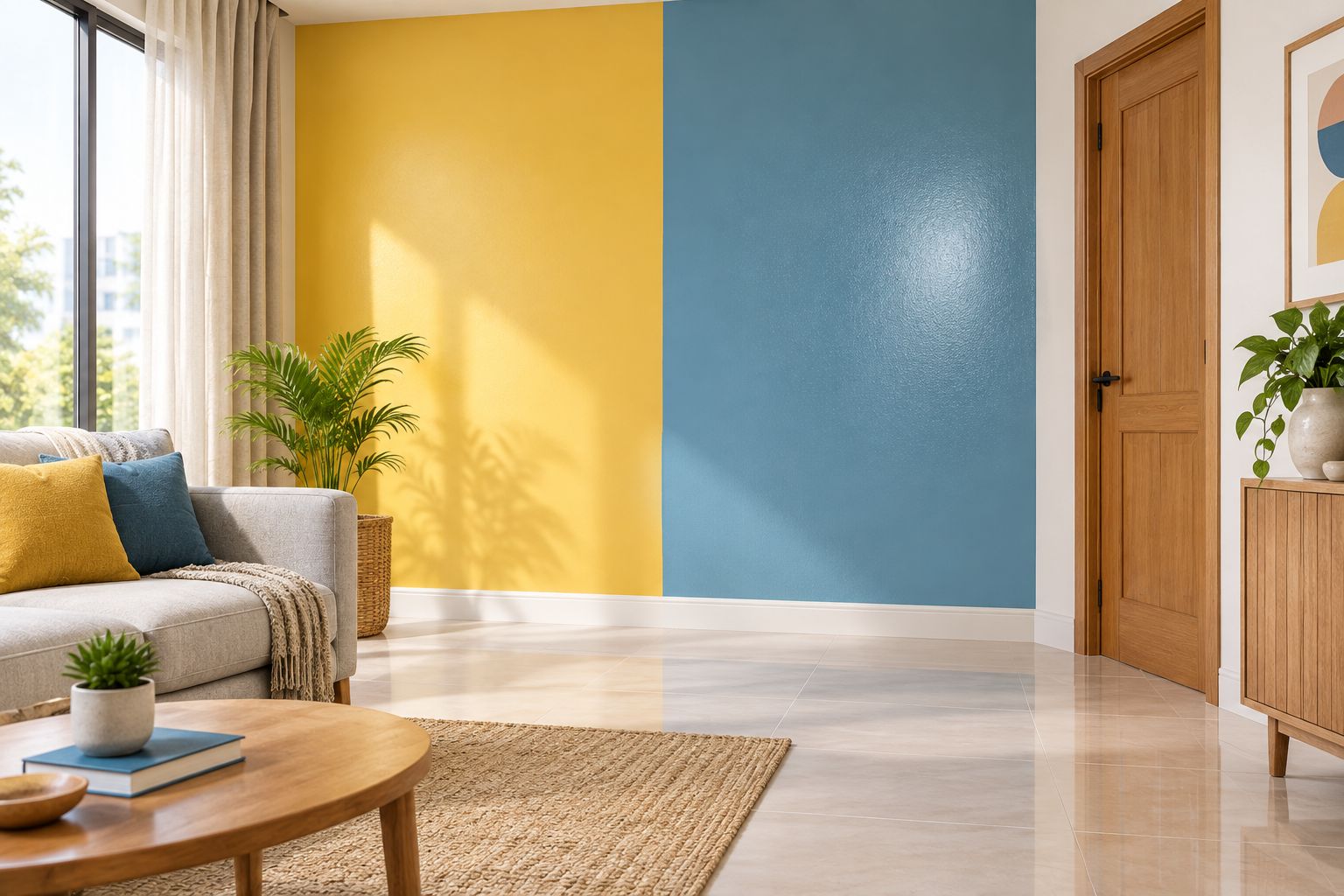
For a 2026 repaint, keep your finish decision separate from the colour name. If you change both colour and sheen between samples, you will not know which change caused your preference.
Both brands need an in-room finish check. Neither a brand name nor a digital colour preview replaces seeing the proposed appearance against your home's existing materials.
Both brands depend on a properly specified preparation system
Preparation is where an apparently simple paint comparison becomes a real job specification. Your painter should identify loose coatings, visible dampness, surface contamination and areas needing repair before proposing the finish coat.
Do not ask decorative paint to solve an unresolved source of moisture. Identify and address the source first, then specify the appropriate preparation and coating system. This applies to either brand.
Use this sequence when discussing the work:
- Inspect: Identify the substrate, existing coating and visible defects.
- Repair: Define which defects need correction before painting.
- Prepare: Specify cleaning and removal of unsound material.
- Prime: Name the primer appropriate to the chosen system.
- Finish: Name the topcoat and follow its published application instructions.
Keep primer and topcoat compatibility within the specified system. A primer is not automatically suitable simply because it comes from the same manufacturer, and mixing products requires a clear technical basis.
Preparation is a tie, not a brand advantage. A good product applied over an unsuitable surface is not evidence of a successful paint specification.
The standout choice is breadth for a new project, continuity for a repaint
The useful distinction is between building a new surface-by-surface schedule and retaining one you already trust. For a new schedule, the named MRF range covers several distinct application categories. For an established Nippon Paint project, continuity keeps your specification anchored to a known result.
Neither choice removes the need to select the actual product. Breadth can create more decisions; continuity can preserve a finish you no longer want. State your goal before accepting either advantage.
A simple brief makes the decision clearer: list each surface, its location, the appearance you want and the problem you need addressed. Ask the painter to respond to that brief rather than recommending a manufacturer alone.
Pricing: compare the job scope, not an unsupported brand ranking
For your 2026 project, compare itemised quotations for the same work. Do not assume either manufacturer is cheaper based on a brand-level reputation. The relevant comparison is the selected product system and the agreed application scope.
Ask each quotation to name the paint, primer, preparation, repair work and labour included. Keep the surfaces and finish requirements consistent. A quote excluding repairs is not directly comparable with one that includes them.
A fixed scope makes quotations easier to compare, but newly discovered damage still needs an agreed process. Ask how additional work will be described and approved before painting begins. This is a project-cost decision, not evidence of either manufacturer's pricing model.
Choose the quotation that clearly specifies the required work. An unexplained total does not tell you whether you are buying the same result.
MRF Paints products for walls, doors, gates and roofs
Build your product discussion around the actual surface. These named options provide a starting point without assigning unverified coverage, drying times or performance figures.
| Surface or task | Products to discuss | Best for |
|---|---|---|
| Interior and exterior wall selection | RUCA, Altura, Visa, AquaFresh, Campus | Homeowners choosing an emulsion for a specified wall application |
| Wood finishing | AquaCoat 1K/2K PU, WoodCoat Italia/Exterior | Homeowners specifying finishes for wooden surfaces |
| Metal coating | MetalCoat, MC+, Durothane, Specta, Epidec | Homeowners planning a separate coating system for metal surfaces |
| Floor painting | Zameen 2K PU | Homeowners with a floor-coating requirement |
| Cool roof coating | AquaFresh Cool | Homeowners specifying a cool roof coating |
Keep primers in the same discussion. AquaFresh PU, Altura, Sello, Solvent Thinnable and DampGarde are named primer options; select the appropriate one for the substrate and finish system rather than substituting by name alone.
Final verdict: choose for your project profile
Choose MRF Paints if you are planning a multi-surface project
Winner for this profile: MRF Paints. Choose it when you want to build a named shortlist covering walls, wooden surfaces, metalwork and specialist applications. Approve the individual product systems rather than treating the whole range as interchangeable.
Choose Nippon Paint if you are continuing a satisfactory specification
Winner for this profile: Nippon Paint. Choose it when the existing Nippon system already gives you the intended result and retaining that specification matters. Inspect and prepare the current surface before repeating it.
| Dimension | Winner or decision |
|---|---|
| New multi-surface shortlist | MRF Paints for the named selection path |
| Wall-emulsion performance | No blanket winner; compare exact products |
| Wood-and-metal selection | MRF Paints for the named starting range |
| Existing satisfactory Nippon specification | Nippon Paint for continuity |
| Finish selection | Tie; compare in the room |
| Surface preparation | Tie; specify the complete system |
| Standout project fit | New shortlist versus existing specification |
| Pricing | Compare equivalent itemised scopes |
FAQ
Is MRF Paints better than Nippon Paint for my home?
MRF Paints is a practical choice for a new multi-surface shortlist; Nippon Paint is a sensible choice for continuing a satisfactory existing Nippon specification. Compare the exact products before deciding on wall finish or performance.
Which MRF product should I use for an iron gate?
MetalCoat is an MRF metal-coating option to discuss for your gate specification. Have the painter define the preparation, primer and intended finish for the metal surface.
Which brand is better for interior walls?
There is no blanket interior-wall winner in this comparison. Compare the exact emulsion, intended finish and published product information against the same room requirements.
Should I switch brands when repainting my house in 2026?
Switch when a different specification addresses a clearly defined requirement. If your existing Nippon system already meets your needs, continuity is a valid reason to retain it.
Can I use the same paint on walls, wooden doors and gates?
Specify coatings separately for walls, wood and metal. A wall-paint choice does not automatically establish suitability for doors or gates.
How should I compare painting quotations?
Compare itemised quotations with the same surfaces, preparation and finish requirements. Each quotation should identify the paint, primer, repairs and labour included.
Will choosing the same shade guarantee a matching touch-up?
The same shade reference does not guarantee an invisible repair against an aged wall. Discuss whether repainting the whole wall is more appropriate for the desired appearance.
One last thing
Before approving paint for your 2026 project, photograph the product specification and keep it with the room name and shade reference. That record makes a later repair discussion more precise than remembering only the manufacturer or colour family.
Related guides
- Exterior wall paints for Indian homes
- Paints for wooden doors and windows
- Paints for iron gates and grills in India
Take your surface list to an MRF Paints dealer and discuss the appropriate products for each task. MRF Paints — Paint the Good Life.