Best Damp Proof Primer for Walls: Top Choices 2026
Best overall: a masonry primer specified for your repaired wall and chosen paint. Best for new plaster: an alkali-resistant primer. Best for old water marks: a compatible stain-blocking primer. The best damp proof primer for walls in 2026 is the one that fits the surface after you fix the source of moisture—not one that promises to hide an active leak.
- The best damp proof primer for walls fits the repaired surface; no primer replaces leak repair.
- Choose an alkali-resistant primer for new plaster when the paint system specifies it.
- Use stain-blocking primer for residual water marks only after the wall is dry.
- From MRF Paints: AquaFresh PU Wall Primer or Altura 2-in-1 Primer for interior and exterior walls, and AquaFresh DampGarde where exterior walls need crack-bridging waterproofing.
Why this matters before the monsoon
A damp patch is a symptom, not a primer specification. Rain entering through an outside crack needs a different response from condensation behind a cupboard or a leaking bathroom pipe.
MRF Paints manufactures wall paints and primers for homeowners and painters in India. MRF’s primers prepare a repaired wall for painting; for exterior walls that let rain in through hairline cracks, AquaFresh DampGarde adds a waterproofing layer. No primer is a substitute for fixing the source of water.
For your 2026 repaint, separate the repair decision from the decorating decision. The wall primer guide provides a broader starting point; this guide ranks primer types by the wall condition they need to address.
What makes the best damp proof primer for walls?
Choose by the job the primer must do. These criteria matter more than a reassuring name on the tin:
- Approved surface: The instructions must name your substrate, such as plaster, concrete or an existing painted wall.
- Permitted moisture condition: Check whether the product requires a dry surface. Do not interpret “damp proof” as permission to coat wet plaster.
- Paint-system compatibility: Confirm the primer works with the repair material, putty and finish you intend to use.
- Specific function: Alkali resistance, stain blocking and adhesion solve different preparation problems. None automatically means waterproofing.
- Application conditions: Follow the stated preparation, drying and recoating requirements rather than applying extra coats by guesswork.
Before you choose, complete 3 inspection checks: identify where the water enters, check whether the wall remains wet, and inspect whether the existing surface is firmly attached. A primer decision made before those checks is premature.
Primer choices at a glance
These 5 primer routes cover different preparation needs. They are not interchangeable, and the ranking does not mean every monsoon-prone home needs the first option.
| Rank and primer type | Best for | Function to confirm in the instructions | Key limitation |
|---|---|---|---|
| 1. Compatible masonry primer | Routine repainting after moisture repairs | Approved preparation for the wall and selected finish | Does not repair the source of damp |
| 2. Alkali-resistant primer | New or repaired cement-based plaster | Suitability for alkaline masonry | Does not replace required curing or drying |
| 3. Exterior masonry primer | Outdoor walls exposed to seasonal rain | Use within the selected exterior coating system | Cannot close untreated cracks or failed joints |
| 4. Bonding primer | Firm, difficult-to-coat existing finishes | Adhesion to the identified surface | Cannot stabilise loose or peeling paint |
| 5. Stain-blocking primer | Residual water marks on dry, repaired walls | Blocking the particular stain beneath the finish | Does not stop continuing water entry |
1. Compatible masonry primer: best for repaired indoor walls
A compatible masonry primer prepares a sound wall for the next coating in the chosen paint system. It is the default starting point when the moisture source has been repaired and the remaining task is an ordinary repaint.
The important word is compatible. Check the complete sequence, including any repair compound or putty, rather than choosing a primer independently of the finish.
Compatible masonry primer pros:
- Gives you a clear preparation route when the wall and finish are both covered by its instructions.
- Avoids adding a specialist treatment without an identified need.
- Fits a room-by-room repaint where you can inspect each wall separately.
Compatible masonry primer cons:
- Does not fix seepage, plumbing leaks or condensation.
- Does not automatically provide stain blocking or suitability for fresh plaster.
Best for: A previously damp interior wall that is now dry, sound and ready for decorating.
Ask your painter to name the primer and finish together. Buy only after confirming the repaired wall meets the primer's preparation requirements.
2. Alkali-resistant primer: best for new cement-based plaster
An alkali-resistant primer addresses the alkaline nature of cement-based surfaces when the paint system calls for it. This makes it a relevant choice for newly plastered areas or cement-based repairs—not a general treatment for every damp patch.
New plaster can be both unfinished and moisture-laden. Those are separate issues: a suitable primer does not remove the need to let the substrate meet the specified curing and drying conditions.
Alkali-resistant primer pros:
- Addresses a specific substrate requirement rather than a vague damp concern.
- Provides a defined choice for new plaster when approved by the coating instructions.
- Helps you distinguish preparation for a repaired patch from preparation for old paint.
Alkali-resistant primer cons:
- Is not a waterproofing repair.
- Cannot justify painting plaster before the required preparation conditions are met.
Best for: New or repaired cement-based plaster whose selected paint system specifies alkali resistance.
For a 2026 renovation, record when plaster repairs were completed and follow the product's instructions—not a fixed waiting period copied from another job. Buy when the substrate and paint system require it.
3. Exterior masonry primer: best for rain-exposed outside walls
An exterior masonry primer belongs beneath an exterior finish when that coating system specifies it. Start with the outside wall's condition: cracks, defective joints and areas around openings need inspection before decorative coatings begin.
Do not move an interior primer outdoors simply because it is already available. Exterior use must be stated in the product information, along with the permitted substrate and preparation.
Exterior masonry primer pros:
- Lets you plan the primer and exterior finish as one coating sequence.
- Keeps the selection focused on an outdoor masonry surface.
- Gives the painter a defined preparation stage after repairs.
Exterior masonry primer cons:
- Cannot replace repairs to cracks, joints or water-entry points.
- Does not automatically qualify as a terrace or roof waterproofing coating.
Best for: Sound exterior masonry being repainted with a compatible exterior wall finish.
Inspect the outside face of a wall when the corresponding indoor patch returns after rain. Painting only the room side leaves that investigation unfinished. Buy as part of the approved exterior system, after repairs.
4. Bonding primer: best for difficult existing finishes
A bonding primer is a specialist preparation choice when the existing, firmly attached finish presents an adhesion problem and the product approves that surface. It is not a way to glue peeling paint back onto a wall.
Identify the old finish before selecting the primer. Cleaning, surface preparation and a trial area remain necessary; the word “bonding” does not remove those steps.
Bonding primer pros:
- Addresses adhesion as a distinct problem rather than confusing it with damp.
- Offers a defined route for an existing surface that the product explicitly supports.
- Supports a trial application before you commit to the full wall.
Bonding primer cons:
- Does not make loose paint or weak plaster sound.
- Is unnecessary when a standard compatible masonry preparation already meets the job's needs.
Best for: A sound existing coating that needs a specifically approved adhesion treatment.
If the wall is flaking, remove the failed material and investigate why it failed before selecting another coating. Hold until the existing surface is identified and confirmed sound.
5. Stain-blocking primer: best for old water marks
A stain-blocking primer is intended to stop specified stains from showing through a new finish. It becomes relevant after the leak has been repaired, the wall has dried and a residual mark remains.
Check that the product covers the stain you have and accepts the planned topcoat. A brown water mark and a powdery white deposit are different surface problems; do not treat both as a stain by default.
Stain-blocking primer pros:
- Targets visible marks rather than adding unnecessary coats of wall paint.
- Separates cosmetic treatment from moisture-source repair.
- Allows a local trial before repainting the complete area.
Stain-blocking primer cons:
- Does not stop an active leak or continuing damp.
- Does not replace cleaning or treatment of mould and salt deposits.
Best for: A dry, repaired wall with a residual stain covered by the primer's instructions.
Watch whether the mark changes after rain or bathroom use. A changing patch needs investigation, not concealment. Buy only for a residual stain after the moisture problem is resolved.
How to choose without painting over the problem
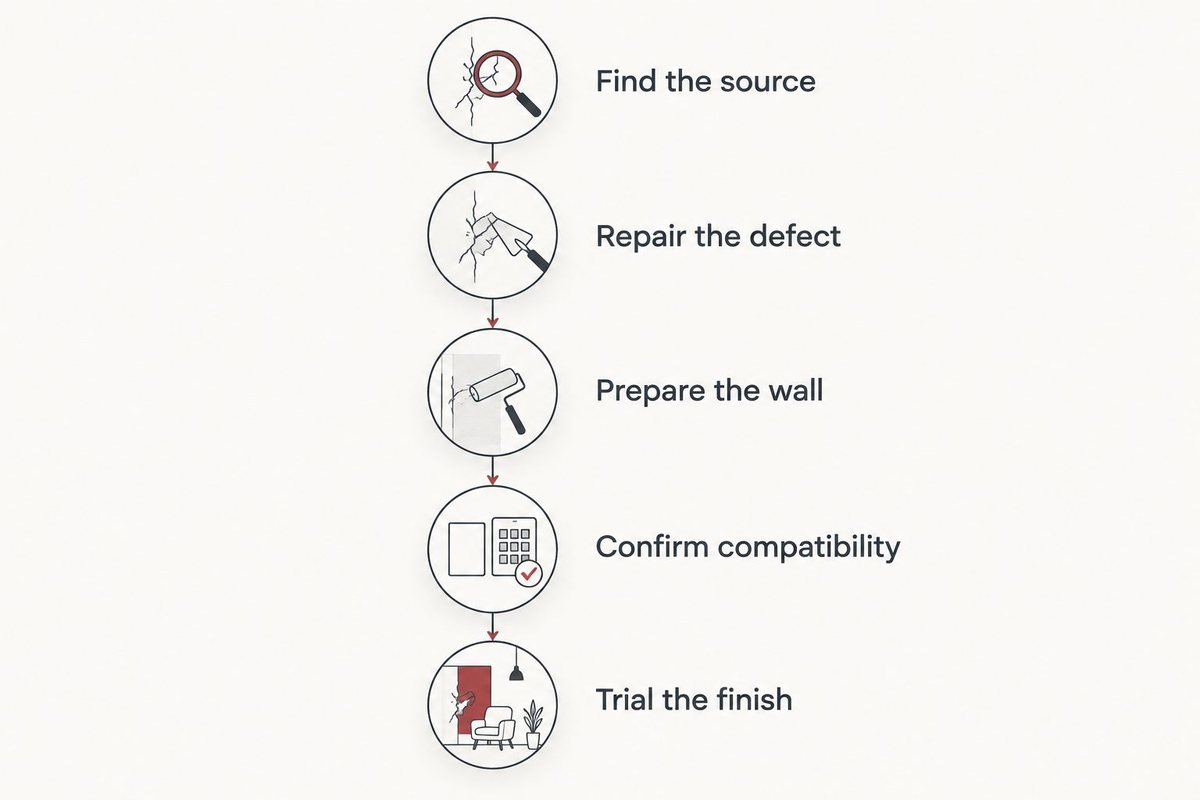
Use this sequence for your 2026 monsoon painting plan. It keeps repairs, preparation and decoration in the right order.
Find the source
Note where the patch appears and what happens before it returns. Check nearby plumbing, the outside wall, roof junctions and ventilation as relevant; ask an appropriate professional to investigate the suspected source.
Do not diagnose rising damp from the patch's height alone. Location is a clue, not proof.
Repair the defect
Resolve the identified water-entry or condensation problem before repainting. Agree with the repair professional which surfaces need treatment and what must happen before coating starts.
An indoor primer is not a substitute for work needed on the outside of the building. Keep roof and terrace repairs separate from wall-paint selection.
Prepare the wall
Remove loose material and follow the coating instructions for cleaning and surface preparation. Investigate persistent mould or white deposits rather than covering them with putty.
Check that the substrate meets the selected product's moisture requirements. A surface that feels dry is not, by itself, proof that deeper masonry is ready.
Confirm compatibility
Ask for the exact primer, repair material, putty and finish proposed for the wall. Read their instructions as a sequence, including restrictions and recoating conditions.
If you use MRF primers, follow the data sheet for the specific primer: coverage and recoat times differ between them (see the MRF products section below).
Trial the finish
Plan 2 sample patches: one on the repaired area and one on nearby sound wall. Apply the proposed preparation and finish sequence to both, following the instructions.
The comparison helps you judge appearance before committing to the room. It is not proof that a leak has been permanently repaired.
How the ranking works
This 2026 ranking starts with the routine repainting choice, then separates primers by the specific problem they address: alkalinity, exterior use, adhesion or staining. It prioritises substrate suitability and compatibility over broad damp-proof wording.
The order is a decision guide, not a measured product-performance comparison. A specialist primer wins only when your wall needs its stated function.
Which wall primer should you choose?
Choose a compatible masonry primer by default once the moisture source is repaired and the wall is ready. Switch to a specialist route only when the substrate or remaining preparation problem requires it.
From MRF Paints, AquaFresh PU Wall Primer and Altura 2-in-1 Primer cover interior and exterior walls, and AquaFresh DampGarde handles exterior walls with hairline cracks. If water is still entering, pause the decorating decision and complete the repair instead.
MRF Paints primers for damp-prone walls
- AquaFresh PU Wall Primer: a water-based polyurethane primer for interior and exterior walls, about 85-95 sq ft per litre per coat, 4-5 hours between coats. Use two coats on fresh walls. It is the recommended primer under the AquaFresh paints.
- Altura 2-in-1 Primer: a water-based acrylic primer for interior and exterior walls, about 90-110 sq ft per litre per coat indoors and 60-80 outdoors.
- Sello 2-in-1 Wall Primer: a budget water-based acrylic primer for interior and exterior walls, about 80-100 sq ft per litre per coat indoors and 50-60 outdoors.
- AquaFresh DampGarde: a fibre-reinforced waterproofing system for terraces and exterior walls that bridges cracks up to 0.5 mm.
For exterior walls, see also our guides to waterproofing paint for exterior walls and paint for monsoon and coastal homes.
FAQ
What’s the best damp proof primer for walls in a monsoon-prone home?
The best choice is a primer approved for your repaired wall and selected finish. Fix the moisture source first, then choose according to the substrate, residual stains and coating instructions.
Can I apply primer directly to a damp wall?
Apply primer only when the wall meets that product’s stated moisture requirements. Do not assume damp-proof wording means the primer is suitable for a wet surface.
Is an alkali-resistant primer better than a normal wall primer?
An alkali-resistant primer is the better choice when the substrate and paint system require alkali resistance. It is not automatically better for an old painted wall or an active leak.
Will stain-blocking primer stop a water patch returning?
Stain-blocking primer does not stop water entering the wall. Use it for a residual stain only after repairs and drying, and confirm that the product covers that stain.
Can I use an interior wall primer on an exterior wall?
Use an interior primer outdoors only if its product instructions explicitly approve exterior use. Match the primer to the outdoor substrate and the selected exterior finish.
Does every damp wall need waterproofing paint?
No; the treatment depends on the cause of the damp. Plumbing leaks, rain entry and condensation require different corrective work before you choose a coating.
How do I choose an MRF Paints primer for a repaired wall?
Match the primer to the topcoat: AquaFresh PU Wall Primer under AquaFresh paints, Altura 2-in-1 Primer under Altura, and Sello 2-in-1 as the budget choice for interior and exterior walls. If an exterior wall has hairline cracks letting rain in, add AquaFresh DampGarde after the repair.
One last thing
Before your 2026 repaint, photograph the patch and note when it changes. Share that record with the person investigating the moisture problem; a freshly painted wall hides useful clues.
Choose primer for the surface you have after repair—not for the damp you hope to cover.
Related guides
- Waterproof paints for terraces and roofs in India
- Exterior wall paints for Indian homes
- Wall texture paint designs for living rooms