Best Floor Paint for Home: Epoxy for Garages | 2026
Best overall for a covered concrete garage: a floor-rated epoxy system. Best for lightly used indoor concrete: acrylic concrete floor paint. Best for exposed outdoor concrete: an exterior-rated polyurethane floor system. This 2026 guide helps you choose the best floor paint for home use by matching the coating to your surface, traffic and exposure—not just the colour.
- The best floor paint for home use must match the surface, traffic and moisture conditions.
- Choose floor-rated epoxy for covered concrete garages; confirm vehicle use in the product instructions.
- Choose exterior-rated polyurethane for exposed concrete only when outdoor suitability is explicitly stated.
- From MRF Paints: Zameen 2K PU Floor Paint for concrete, paver blocks and floor tiles; AquaCoat PU 2K floorcoats for wooden floors.
- Tile floors and wet areas need explicit surface approval and suitable slip resistance.
Why this matters
A wall paint, wood finish or metal enamel is not automatically suitable for a floor. Floors face shoes, furniture movement, cleaning and, in garages, vehicle tyres. The product instructions must cover those uses.
MRF Paints makes a floor-specific coating, Zameen 2K PU Floor Paint, for concrete, paver blocks and floor tiles (see the MRF products section below).
The best floor paint is the one approved for your surface and use—not the one with the most attractive shade. For your 2026 project, settle the coating system before choosing the colour.
What makes the best floor paint for home use?
Use these criteria before comparing options. Each one answers a different question about whether a coating belongs on your floor.
- Surface approval: Does the product information specifically name concrete, cement screed, tile or your existing surface?
- Traffic suitability: Is the coating intended for walking, furniture movement or vehicle use? These are different demands.
- Moisture conditions: Does the installation guidance require moisture testing, a dry substrate or a particular primer?
- Exposure: Is the complete system suitable for indoor use, outdoor sunlight or rain exposure?
- Slip resistance: Does the proposed finish suit a dry room, entrance or regularly wet area? Appearance alone cannot answer this.
- Application requirements: Can your painter meet the preparation, mixing, recoating and curing instructions?
Treat a coating system as the complete combination of preparation, primer, finish and any specified texture. Changing one part without checking compatibility turns a clear specification into guesswork.
Floor paint options at a glance
This ranking compares coating types, not named products or laboratory test results. Read it as a decision tree: choose the row that matches your floor, then verify the actual product specification.
| Rank and option | Best for | Standout selection benefit | Key limitation |
|---|---|---|---|
| 1. Floor-rated epoxy system | Covered concrete garages | A defined resin system for a prepared concrete floor | Requires careful preparation; outdoor suitability is not automatic |
| 2. Acrylic concrete floor paint | Lightly used indoor concrete | A painted finish without choosing a reactive resin system | Do not assume suitability for cars or heavy wear |
| 3. Exterior-rated polyurethane floor system | Exposed outdoor concrete | Lets you specify a system intended for outdoor exposure | Not every polyurethane coating is floor-rated or sunlight-suitable |
| 4. Tile-compatible floor coating | Renovating existing tiled floors | Keeps the existing floor while changing its appearance | Adhesion depends on tile approval and preparation |
| 5. Textured slip-resistant floor system | Wet entrances and utility areas | Makes wet-use suitability part of the specification | Texture changes cleaning and does not eliminate slipping |
1. Floor-rated epoxy: best for covered concrete garages
A floor-rated epoxy system is the starting point for a covered concrete garage in this guide. Epoxy coatings use a reactive resin system; the selected product determines the mixing method, primer and application requirements. Choose one that explicitly permits vehicle traffic.
Do not buy a general-purpose epoxy simply because its label mentions strength. Garage suitability also depends on the condition of the concrete, contamination, moisture and the specified return-to-use period.
Floor-rated epoxy pros:
- Gives you a defined system to specify for a prepared concrete floor.
- Allows garage suitability to be checked against written vehicle-use guidance.
- Offers a continuous finish when installed as specified.
Floor-rated epoxy cons:
- Oil contamination and poorly prepared concrete interfere with adhesion.
- Reactive systems require the stated mixing and working procedures.
- Ordinary epoxy should not be assumed suitable for direct sunlight.
Best for: A covered concrete garage where the selected system explicitly permits parked vehicles and your installer can complete the preparation.
For a 2026 garage repaint, ask the painter to inspect the existing coating before proposing another layer. Loose paint must not become the foundation of the new finish. Also distinguish between permission to walk on the floor and permission to park a car on it.
Verdict: Buy a garage-approved epoxy system for sound, prepared concrete; skip unspecified epoxy coatings.
2. Acrylic concrete floor paint: best for light indoor use
Acrylic concrete floor paint is an option for a dry indoor concrete space used mainly for walking. Think of a lightly used store room or similar area where you want a painted appearance rather than a vehicle-rated floor system.
The word acrylic describes the binder, not a guarantee of floor suitability. The actual product must name concrete floors and describe the intended traffic.
Acrylic concrete floor paint pros:
- Provides a colour-change option for approved concrete surfaces.
- Suits a straightforward painted-floor brief when light use is specified.
- Lets you assess future repainting through the product's maintenance instructions.
Acrylic concrete floor paint cons:
- Vehicle suitability must not be inferred from concrete approval.
- Furniture movement and abrasive dirt still matter when selecting the product.
- It does not correct dampness, loose concrete or structural cracks.
Best for: A dry, lightly used indoor concrete floor without vehicle traffic.
Before choosing this option, describe the room honestly. A store room used occasionally is different from a workshop where equipment is dragged across the floor. Ask how the selected finish should be cleaned and repaired; those instructions matter after the first coat looks fresh.
Verdict: Buy for approved light-use indoor concrete; skip for a garage unless vehicle use is explicitly permitted.
3. Exterior-rated polyurethane: best for exposed concrete
An exterior-rated polyurethane floor system is the option to investigate for concrete exposed to sunlight and weather. The important words are exterior-rated and floor system. A polyurethane wood finish does not become a floor coating merely because it uses the same binder family.
Polyurethane formulations differ. Confirm outdoor exposure, substrate approval and whether the proposed system needs a compatible base coat or primer.
Exterior-rated polyurethane pros:
- Makes outdoor exposure an explicit selection requirement.
- Allows you to specify the complete primer-and-finish combination.
- Provides a route to a coloured outdoor floor where the product permits it.
Exterior-rated polyurethane cons:
- Polyurethane alone does not establish sunlight resistance or floor suitability.
- Application conditions and compatibility need careful checking.
- A floor finish is not automatically a roof-waterproofing system.
Best for: Exposed concrete balconies or outdoor floor areas approved by the selected product's instructions.
For a 2026 balcony project, separate appearance from water management. Check drainage and existing waterproofing before discussing the finish. If preventing roof leakage is the real objective, use the waterproof paints for terraces and roofs guide to frame that separate decision.
Verdict: Buy only a documented exterior floor system; skip generic polyurethane finishes for exposed concrete.
4. Tile-compatible coating: best for changing existing tiles
A tile-compatible floor coating offers a way to change the appearance of an existing tiled floor without removing every tile. This is a substrate-specific choice: approval for walls, ceramic surfaces or decorative objects is not enough.
Your installer must assess loose tiles, grout joints, cleaning residues and the surface preparation required by the coating manufacturer. A painted layer cannot stabilise a loose tile underneath it.
Tile-compatible floor coating pros:
- Retains the existing tiled surface where it is sound.
- Allows a colour change without making tile replacement the starting point.
- Makes tile-specific adhesion preparation part of the plan.
Tile-compatible floor coating cons:
- Smooth or glazed tiles require the specified preparation and primer.
- Grout lines remain unless an approved system addresses them.
- Wet-area suitability needs separate confirmation.
Best for: Sound indoor tiles where changing the appearance is the goal and the coating explicitly permits floor use.
Do not treat a successful patch on one tile as approval for the entire room. Follow the manufacturer's test procedure and examine the condition of the whole floor. Ask how edges, thresholds and grout joints will be handled before accepting the proposed finish.
Verdict: Hold until tile-floor approval and preparation are confirmed; skip general wall or tile paint.
5. Textured floor system: best for wet entrances
A textured slip-resistant floor system puts wet-use conditions ahead of a smooth decorative finish. Depending on the product, texture comes from the coating itself or from a specified aggregate added within the system.
This is a performance requirement rather than a separate paint chemistry. An epoxy or polyurethane system can also fall into this category, but the recommendation here is specifically for regularly wet walking areas.
Textured floor system pros:
- Makes slip resistance part of the purchase brief.
- Allows the texture and cleaning method to be considered together.
- Directs attention to entrances, utility floors and other wet-use locations.
Textured floor system cons:
- A textured surface does not eliminate slipping.
- Coarser texture can make dirt removal more demanding.
- Site-added sand is not a substitute for an approved specification.
Best for: Wet entrances and utility areas where the selected system documents suitability for the expected conditions.
Ask for relevant slip-resistance information rather than accepting anti-skid as a complete explanation. Consider drainage, footwear, cleaning and standing water together. For households with children or older family members, include these practical needs in the brief without assuming a coating alone resolves them.
Verdict: Buy a specified wet-use system; skip improvised texture added without manufacturer approval.
Choose your floor system before your colour
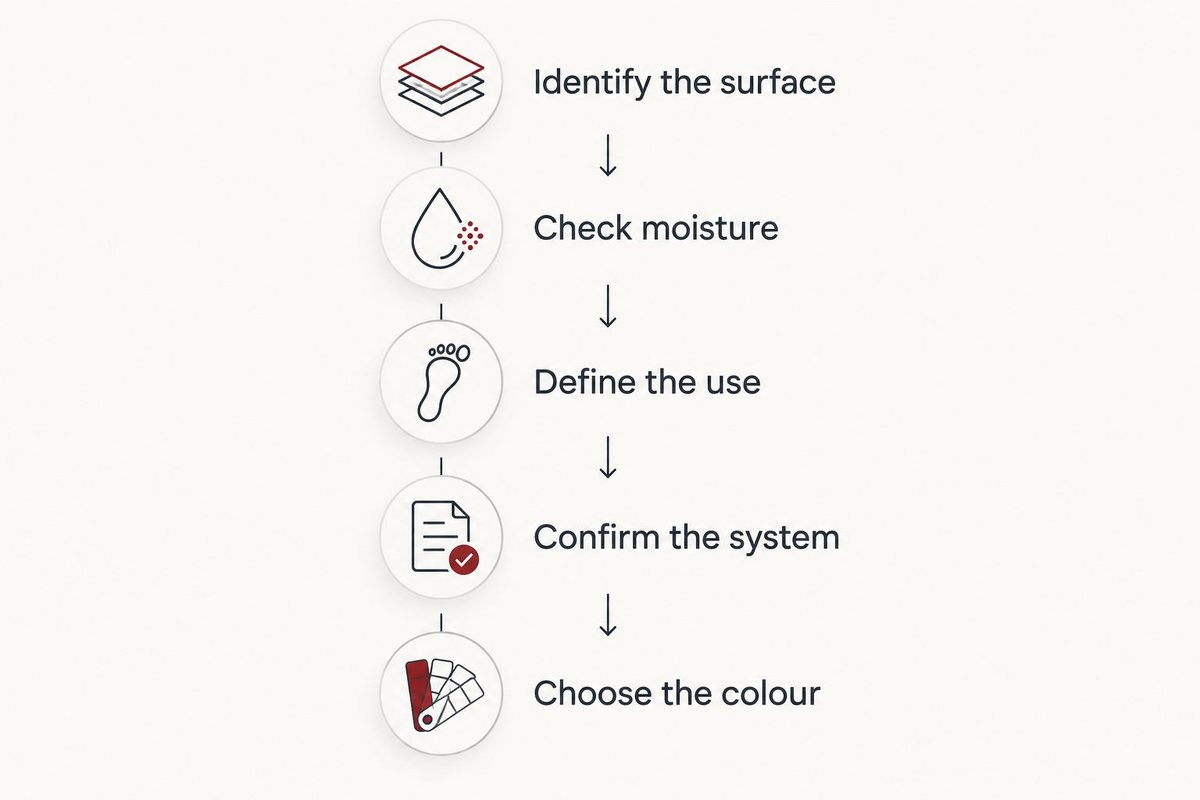
Use this sequence for your 2026 painting plan. It keeps a shade preference from deciding a technical choice too early.
- Identify the surface: Record whether the floor is concrete, cement screed or tile, and whether an old coating remains.
- Check moisture: Ask your installer to follow the selected system's moisture-assessment requirements before coating.
- Define the use: List walking, parking, furniture movement, rain exposure and routine cleaning.
- Confirm the system: Get the preparation, primer, finish and return-to-use instructions in writing.
- Choose the colour: Review the shade only after the coating has passed the earlier checks.
For colour selection, use 2 sample patches in different parts of the floor, following the coating's sampling instructions. Review them at 3 times of day—morning, afternoon and evening—because daylight and artificial lighting change the appearance. Compare 2 written quotations against the same preparation and coating specification, not just the finish name.
If you choose MRF’s Zameen, give your painter the floor material and exposure so the data sheet’s preparation, primer and recoat steps are followed.
How these options are ranked
The ranking prioritises surface approval, traffic, moisture, exposure, slip resistance and application requirements. It does not rank brands or claim that one binder performs identically across every formulation.
Epoxy takes the first position for the covered concrete garage use case. Acrylic serves light indoor use; exterior-rated polyurethane addresses exposure; tile-compatible systems address adhesion to tiles; textured systems address wet walking conditions.
Which floor paint should you choose?
For a covered concrete garage, start with a garage-approved epoxy system. For a lightly used indoor concrete room, start with floor-rated acrylic. For an exposed area, move to a documented exterior system rather than adapting an indoor coating.
The practical 2026 default is simple: choose by use, then verify the product. From MRF Paints, that means Zameen 2K PU Floor Paint for concrete, pavers and tiles, and the AquaCoat PU 2K floorcoats for wooden floors.
MRF Paints floor coatings
- Zameen 2K PU Floor Paint: a two-pack polyurethane paint for paver blocks, floor tiles and concrete, in 11 shades, with a 4-year warranty. It fits the polyurethane and tile-compatible options above. Clean and scuff the surface, apply the primer specified on the data sheet, then two coats of Zameen 10-12 hours apart. Check the data sheet before parking vehicles on a coated floor.
- AquaCoat PU 2K Floorcoat Clear and Anti-skid Floorcoat Clear: two-pack water-based polyurethane clear finishes for wooden floors, with an anti-skid version where slipping is a concern.
To buy, use the MRF Paints dealer locator.
FAQ
What’s the best floor paint for home use?
The best floor paint for home use is a coating explicitly approved for your floor material and expected traffic. Start with garage-approved epoxy for covered concrete garages and floor-rated acrylic for light indoor concrete use.
Is epoxy better than acrylic for a home garage?
A garage-approved epoxy system is the starting choice here for a covered concrete garage. Acrylic concrete paint should not be used for parked vehicles unless its instructions explicitly permit that use.
Can I use wall paint on a concrete floor?
Do not use wall paint on a floor unless the manufacturer explicitly approves that application. Wall suitability does not establish resistance to foot traffic, furniture movement or vehicle use.
Can I paint over existing floor tiles?
You can coat existing tiles only with a system approved for that tile surface and floor use. Check tile stability, grout condition and the specified cleaning, preparation and primer requirements first.
Which floor paint should I choose for a balcony?
Choose a floor system explicitly approved for outdoor exposure and your balcony’s surface. Check drainage and waterproofing separately; a decorative floor finish is not automatically a waterproofing system.
How long should I wait before parking on a painted garage floor?
Wait for the vehicle-return period stated in the selected coating’s instructions. Dry-to-touch and pedestrian-use times do not establish when the floor is ready for a car.
Does MRF Paints have a suitable coating for my floor?
Yes. Zameen 2K PU Floor Paint is MRF’s two-pack polyurethane paint for concrete, paver blocks and floor tiles, in 11 shades with a 4-year warranty. For wooden floors, MRF makes AquaCoat PU 2K Floorcoat Clear and Anti-skid Floorcoat Clear.
One last thing
The handover instruction matters as much as the shade card. Before painting starts, agree on when walking, furniture placement, cleaning and vehicle parking can resume under the selected product's instructions. Dry to the touch is not the same as ready for every use.
Related guides
- Best exterior wall paints for Indian homes
- Best wall primers in India
- PU wood finishes for Indian furniture