Best paints for bathroom and kitchen walls in India 2026
Best overall: a washable acrylic emulsion explicitly recommended for bathroom walls. Best for frequently wiped kitchen walls: a washable semi-gloss interior paint. Best for dry kitchen corners: a washable matte emulsion. This 2026 guide ranks paint types by where you will use them, rather than treating every bathroom or kitchen wall as the same surface.
- The best paint for bathroom walls is washable interior paint with documented bathroom suitability, not simply a glossy finish.
- Choose kitchen wall paint by cleaning requirements; confirm stain resistance and permitted cleaning methods before buying.
- MRF Paints sells interior wall paints; check each product’s stated suitability before choosing it for bathrooms or kitchens.
- Repair leaks and dampness before painting. Decorative wall paint does not replace a waterproofing system.
Why this matters
Bathroom walls face condensation and splashes; kitchen walls collect cooking residue and marks. The right choice depends on the wall’s exposure, ventilation and cleaning routine—not just its colour.
For homeowners choosing MRF Paints interior wall paints, bathroom suitability matters more than sheen. Start with the MRF Paints range, then check the chosen product’s application instructions for your particular wall.
An upper bathroom wall is different from a shower enclosure. A kitchen dining corner is different from the wall beside the hob. Separate these areas before choosing paint, and you avoid asking one decorative finish to do every job.
What makes the best bathroom and kitchen wall paint?
Use these criteria for your 2026 shortlist. A finish name alone does not establish suitability.
- Room suitability: Look for an explicit recommendation for interior bathroom or kitchen walls. Exterior weather resistance is not a substitute.
- Cleaning instructions: Check whether the coating permits wiping or washing, which cleaners are allowed and when cleaning can begin.
- Moisture suitability: Distinguish humid air and occasional splashes from repeated direct water exposure. They require different decisions.
- Documented mould resistance: Choose a coating with a stated mould-resistance claim when that feature matters. Do not infer it from colour or gloss.
- Surface compatibility: Confirm suitability for your plaster, existing coating, primer and any repairs. The layers must work together.
- Appearance under light: Compare sheen and colour on the actual wall. Reflected light can make uneven plaster more noticeable.
Do not use the words washable, waterproof and mould-resistant interchangeably. Washability concerns cleaning; waterproofing concerns water protection; mould resistance concerns biological growth on the coating. Check each requirement separately.
Bathroom and kitchen paint types at a glance
These are 5 paint types, ranked by distinct use cases. Specific formulations differ, so the manufacturer’s instructions take precedence over the general finish descriptions below.
| Rank and paint type | Best for | Standout selection criterion | Key limitation |
|---|---|---|---|
| 1. Bathroom-rated washable acrylic emulsion | General bathroom walls outside direct shower spray | Explicit bathroom suitability and cleaning instructions | Does not automatically provide waterproofing |
| 2. Washable semi-gloss interior paint | Kitchen walls that need frequent wiping | Documented washability with a reflective finish | Reflections can reveal surface unevenness |
| 3. Mould-resistant interior wall paint | Humid bathrooms with a resolved moisture problem | Explicit mould-resistance claim | Cannot repair leaks or replace ventilation |
| 4. Washable matte interior emulsion | Dry kitchen dining corners and adjoining walls | Low-sheen appearance with documented cleaning suitability | Matte appearance does not guarantee stain resistance |
| 5. Specified wet-area coating system | Walls exposed to repeated direct water | Written approval for the exact wet-area application | Requires a complete compatible system, not a finish-only choice |
1. Washable acrylic emulsion: best for general bathroom walls
A bathroom-rated washable acrylic emulsion is the default choice for painted walls away from direct shower spray. It provides a decorative interior finish; select the formulation by its stated room suitability and cleaning requirements.
Choose this category for upper walls, the wall around the doorway and other areas that face humid air rather than repeated running water. Do not extend that recommendation into a shower enclosure without explicit approval for that exposure.
Washable acrylic emulsion pros:
- Gives you a practical starting point for ordinary painted bathroom walls.
- Lets you choose colour separately from the moisture-suitability decision.
- Provides cleaning guidance when the product documents its washability.
Washable acrylic emulsion cons:
- The acrylic emulsion label does not establish bathroom suitability by itself.
- Decorative paint cannot correct damp plaster or a leaking pipe.
Best for: Homeowners repainting general bathroom walls outside directly wetted areas.
Ask for the technical information before settling on a shade. Confirm the recommended primer, surface condition and drying requirements, then follow the full application sequence rather than mixing unrelated products by habit.
Verdict: Buy a bathroom-rated formulation for general walls; skip one without stated suitability.
2. Washable semi-gloss paint: best for frequently wiped kitchen walls
Semi-gloss describes a visibly reflective finish, not a cleaning-performance guarantee. For kitchen walls, choose an interior formulation that separately documents washability and suitability for the intended surface.
This category suits homeowners who prefer a reflective appearance in areas where marks require regular attention. Near the hob, account for the appliance manufacturer’s heat clearances and use an appropriate splashback where required; decorative paint is not a heat shield.
Washable semi-gloss paint pros:
- Offers a defined reflective look for a kitchen scheme.
- Gives frequently cleaned walls a finish option when washing is explicitly permitted.
- Can create a deliberate visual distinction from adjoining matte walls.
Washable semi-gloss paint cons:
- Reflected light can draw attention to uneven plaster and repair patches.
- Sheen alone does not prove resistance to grease, stains or repeated scrubbing.
Best for: Kitchen walls that need frequent wiping and where you want a reflective finish.
Before choosing semi-gloss in 2026, compare it with other interior wall paint finishes. Make the comparison on your wall, not only on a small printed shade card.
Verdict: Buy when documented cleaning suitability matches your routine; skip if you dislike visible reflections.
3. Mould-resistant paint: best for humidity-prone bathrooms
Mould-resistant interior paint is a targeted choice when its published information explicitly states that property. It belongs in the discussion after you address leaks, recurring condensation and inadequate ventilation—not instead of addressing them.
If mould returns in the same corner, investigate the cause before repainting. Follow appropriate cleaning and safety guidance, and obtain professional help for extensive growth or an unresolved building defect.
Mould-resistant paint pros:
- Addresses a specific coating requirement rather than relying on a generic finish name.
- Helps you shortlist products using an explicit, checkable claim.
- Keeps room suitability and moisture management central to the decision.
Mould-resistant paint cons:
- Does not stop water entering through a leak or defective construction.
- Does not remove the need for ventilation and appropriate surface preparation.
Best for: Humidity-prone bathrooms where the underlying moisture problem has been addressed.
MRF Paints offers interior wall paints, but select a mould-resistant formulation only when the relevant product information states that claim. Do not assume the entire interior range has the same properties.
Verdict: Buy for a documented mould-resistance requirement after fixing the cause; hold while dampness remains unresolved.
4. Washable matte emulsion: best for dry kitchen dining corners
A washable matte emulsion combines a low-sheen appearance with the cleaning properties documented for that formulation. It is a useful option for dry kitchen corners, breakfast areas and adjoining walls where a reflective finish is not your preference.
Keep the recommendation tied to exposure. A wall beside a dining table has different demands from a wall receiving sink splashes or cooking residue.
Washable matte emulsion pros:
- Creates a low-sheen appearance across adjoining living and dining spaces.
- Avoids the pronounced reflections associated with glossier finishes.
- Offers a washable option when the formulation explicitly permits cleaning.
Washable matte emulsion cons:
- Matte appearance alone says nothing about stain resistance.
- A dry-area choice should not be carried into directly wetted zones without approval.
Best for: Dry kitchen dining corners and adjacent walls where appearance takes priority over frequent washing.
Choose the finish before finalising the colour. The same shade can look different as reflections change, so compare samples in the finish you actually intend to apply.
Verdict: Buy for dry adjoining walls with verified cleaning suitability; skip as an automatic whole-kitchen solution.
5. Wet-area coating system: best for direct water exposure
A specified wet-area coating system is a different decision from ordinary decorative wall paint. Consider it only when the manufacturer explicitly approves the complete system for your wall material and its direct-water exposure.
The specification can involve preparation, repairs, primers and compatible finishing layers. Follow the stated system rather than choosing a topcoat because its name includes waterproof.
Wet-area coating system pros:
- Makes direct-water exposure an explicit selection requirement.
- Establishes compatibility between preparation and finishing layers.
- Provides a clear specification to discuss with your applicator.
Wet-area coating system cons:
- Requires more application-specific checking than a decorative finish choice.
- Approval for a roof, terrace or exterior wall does not establish shower-wall suitability.
Best for: Directly wetted walls where a coating system has written approval for that exact application.
Do not assume that MRF Paints specialty coatings are interchangeable across surfaces. Confirm the intended application and use an approved wet-area finish where ordinary interior paint is unsuitable.
Verdict: Hold until the full wet-area specification is confirmed; skip ordinary emulsion inside direct shower spray.
How to choose paint for your home
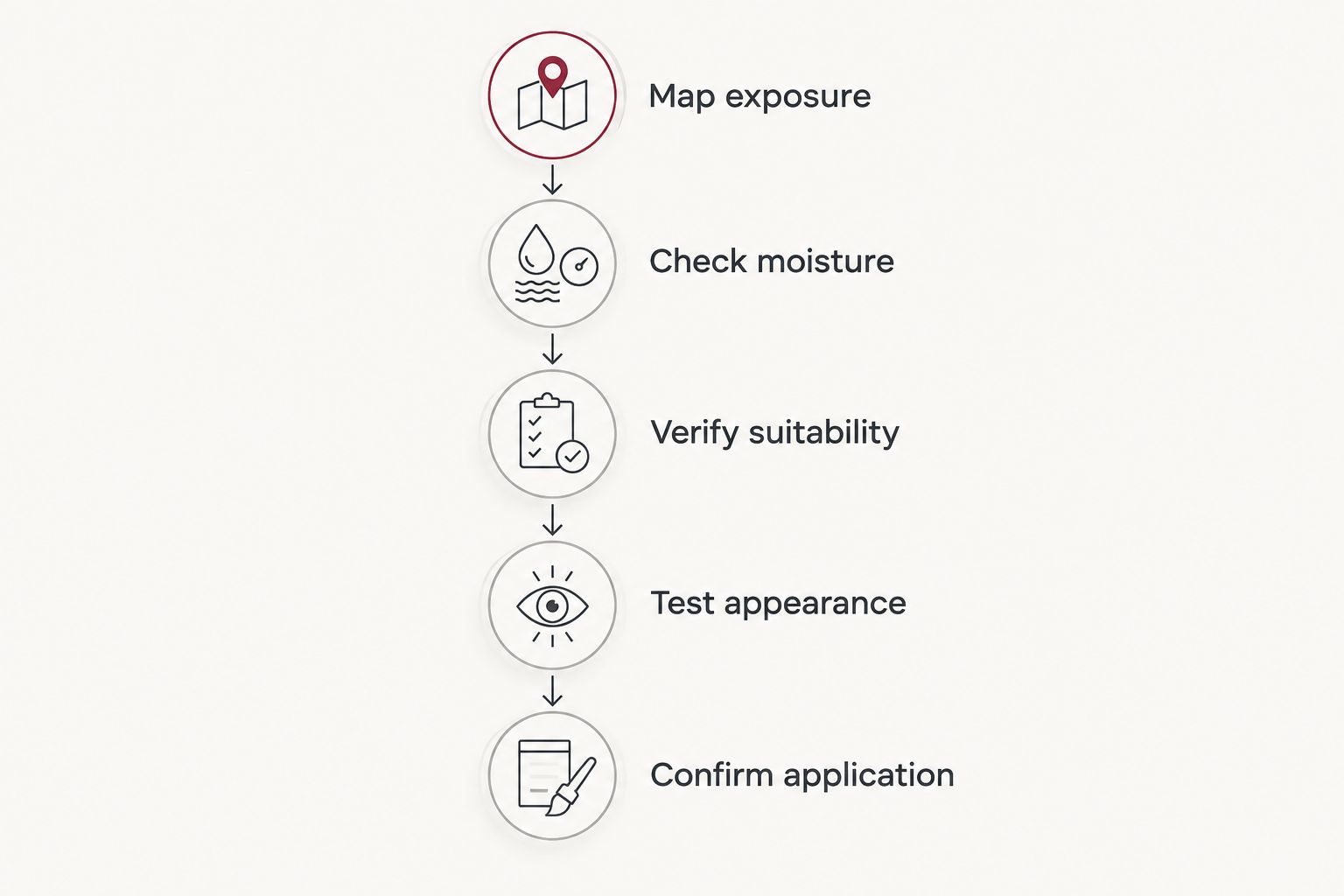
Use this sequence before asking your painter to begin. It turns a broad 2026 paint shortlist into a room-specific decision.
Map exposure
Mark which walls are dry, occasionally splashed or directly wetted. Include the sink edge, shower area and cooking zone, rather than labelling the whole room simply bathroom or kitchen.
Check moisture
Look for active leaks, recurring damp patches, peeling coatings and mould. Resolve the cause before covering the surface; new colour does not make an unsound wall ready for paint.
Verify suitability
Ask for the chosen product’s application and cleaning instructions. Match the room, wall material, primer and exposure to those instructions, including any restrictions.
Test appearance
Apply samples in 2 wall areas: one receiving stronger light and one in shade. Compare the intended finishes, not just the shades.
Confirm application
Agree on surface preparation and the complete compatible coating system. Use the manufacturer’s stated drying and curing intervals instead of a generic timetable.
Choose colours without creating extra work
For your 2026 bathroom palette, compare warm white, soft grey or a muted colour against the actual tiles and sanitaryware. These are starting points, not rules. Existing materials should guide the choice.
In the kitchen, place samples beside cabinet fronts, the worktop and the splashback. A colour that looks balanced alone can appear different beside a strongly coloured stone or laminate.
Review samples at 3 viewing times: morning, afternoon and evening. This is a practical comparison routine, not a paint-performance test. Include the artificial lighting you normally use after dark.
A simpler scheme is easier to judge. Choose one main wall colour, then decide whether a dry dining corner needs a contrasting shade or finish.
How the paint types are ranked
This 2026 ranking prioritises room suitability, cleaning requirements, moisture exposure, surface compatibility and appearance. General bathroom walls come first; specialised exposure and appearance-led choices follow in their own use-case slots.
The ranking compares categories, not tested individual formulations. Product instructions determine whether a particular paint belongs in a recommended category.
Which bathroom and kitchen paint should you choose?
Choose bathroom-rated washable acrylic emulsion for general bathroom walls outside direct water exposure. For frequently wiped kitchen walls, compare documented cleaning suitability first and select semi-gloss only if you want its reflective appearance.
Use washable matte for dry adjoining areas. Treat mould resistance as a specific documented requirement, and direct shower exposure as a separate wet-area specification.
When considering MRF Paints bathroom and kitchen wall paint options, follow this order: exposure, product suitability, compatible preparation, finish, then colour. That keeps the attractive choice aligned with the practical job.
FAQ
What’s the best paint for bathroom walls in India in 2026?
A washable interior acrylic emulsion explicitly recommended for bathrooms is the default choice for walls outside direct shower spray. Check its surface, primer and cleaning instructions before selecting it.
Is semi-gloss paint better than matte paint for kitchen walls?
Neither finish is automatically better; documented cleaning suitability matters more than sheen. Choose semi-gloss for a reflective appearance and washable matte for low-sheen dry areas, subject to the formulation’s instructions.
Can I use normal interior paint inside a shower?
Do not use ordinary interior paint inside direct shower spray unless its manufacturer explicitly approves that application. Choose an approved wet-area finish and follow the complete specified system.
Will bathroom paint stop dampness or mould?
Decorative bathroom paint does not repair leaks or resolve condensation. Address the moisture source first, then choose a coating with documented mould resistance if that property is needed.
Can I use the same paint in my kitchen and bathroom?
Yes, if the product instructions explicitly suit both rooms and their actual exposure conditions. Direct shower water, sink splashes and dry dining walls still require separate checks.
Do bathroom walls need primer before painting?
Use the primer and preparation specified for the wall condition and selected topcoat. New plaster, repairs and existing coatings should not automatically receive the same preparation.
How do I choose MRF Paints for bathroom walls?
Choose MRF Paints interior wall paint by checking the specific product’s bathroom suitability, cleaning instructions and compatible primer. Do not infer waterproofing or mould resistance from the brand name or finish.
One last thing
Before approving the painter’s selection, ask: Does this coating suit this exact wall, or only this type of room? That question separates a dry upper wall from a shower enclosure—and prevents a finish recommendation from becoming an unsupported waterproofing claim.
Related guides
- Wall primers for Indian homes
- Damp-proof wall primers for monsoon-prone homes
- Waterproof paints for terraces and roofs