
Best waterproofing paints for exterior walls in India 2026
Best overall for rain-exposed walls: an elastomeric exterior wall coating with documented suitability for your surface. Best for sound walls: acrylic exterior emulsion. Best for targeted masonry waterproofing: a cementitious system. The best waterproofing paint for exterior walls in India in 2026 depends on where water enters, not just the finish you prefer.
- Choose the best waterproofing paint for exterior walls by matching the coating to the source of dampness.
- Elastomeric exterior wall coatings suit rain-exposed walls when their technical instructions confirm the intended use.
- Acrylic exterior emulsion suits sound walls; roof leaks and rising damp need separate treatment.
- MRF Paints offers exterior wall paints and special coatings; confirm the chosen product’s wall-waterproofing suitability before purchase.
Why this matters
An outside wall can look dry while water enters through a cracked parapet, a window joint or the terrace above it. Painting the visible patch without fixing that route leaves the underlying problem untouched.
For your 2026 repaint, separate decoration from waterproofing. A coating intended to resist rain on an exterior face is not automatically suitable for standing water, moisture rising from the ground or a leaking pipe.
MRF Paints is a relevant starting point for homeowners comparing exterior wall paints and special coatings. Choose a named product only after checking its stated uses, surface requirements and application instructions.
What makes the best exterior wall waterproofing paint?
Use these criteria before comparing colours or finish samples:
- Correct application: The instructions must explicitly include exterior vertical walls and your wall material.
- Moisture diagnosis: Establish whether the problem is rain penetration, a roof leak, plumbing leakage or rising damp.
- Crack treatment: Check which cracks require repair before coating and whether any crack-bridging claim is documented.
- System compatibility: Confirm that repairs, primer and finish are intended to work together.
- Application conditions: Follow the specified surface dryness, weather window and drying requirements.
- Finish suitability: Decide whether you need a coloured finish, a preparatory waterproofing layer or a clear treatment.
For colour and finish choices after that diagnosis, use the guide to exterior wall paints for Indian homes. Waterproofing suitability comes first; appearance comes next.
Exterior wall waterproofing options at a glance in 2026
These are coating categories, not interchangeable products. The order reflects their fit for different household problems, rather than a claim that every product within a category performs equally.
| Rank and option | Best for | Standout characteristic | Key limitation |
|---|---|---|---|
| 1. Elastomeric exterior wall coating | Rain-exposed, rendered walls requiring a flexible finish | Forms a flexible surface film | Crack treatment and permitted substrates remain product-specific |
| 2. Acrylic exterior emulsion | Sound walls needing an exterior decorative finish | Combines colour with an exterior paint finish | The category name alone does not establish waterproofing performance |
| 3. Cementitious waterproofing system | Compatible masonry needing a preparatory waterproofing layer | Provides a cement-based treatment | Decorative finishing and movement tolerance need separate checks |
| 4. Clear masonry water repellent | Exposed masonry where you want to retain its appearance | Reduces water absorption without an opaque painted finish | Does not fill open cracks or repair leaking joints |
1. Elastomeric coating: best for rain-exposed rendered walls
An elastomeric exterior wall coating forms a flexible film over a prepared surface. It is the first category to investigate when rain strikes the wall directly and you want a painted finish rather than exposed masonry.
Do not treat flexibility as permission to paint over every crack. The product instructions must explain its intended substrates, preparation and any claimed crack-bridging ability. Moving cracks and damaged render require assessment before coating.
Elastomeric coating pros:
- Provides a flexible finish rather than a rigid cement-based surface treatment.
- Allows you to consider waterproofing and decorative appearance within the same coating system.
- Is a relevant category for walls directly exposed to wind-driven rain, subject to the product’s stated use.
Elastomeric coating cons:
- Does not repair structural movement, open joints or a leaking terrace.
- Requires careful preparation; weak paint or loose render remains a weak base beneath the new coating.
- Performance claims cannot be transferred from one elastomeric product to another.
Best for: A homeowner with a sound rendered wall, direct rain exposure and a preference for an opaque coloured finish.
Ask your painter to identify the crack repairs and primer before naming the topcoat. If the proposal consists only of applying a thick layer over existing damage, stop and resolve the preparation plan.
Verdict: Buy only when the selected elastomeric coating explicitly supports exterior wall waterproofing on your prepared surface.
2. Acrylic exterior emulsion: best for sound walls needing colour
Acrylic exterior emulsion is a decorative paint category for outside walls. It belongs on your shortlist when the wall is sound and the main job is repainting, not correcting an unresolved leak.
An exterior label establishes an intended location, not proof of a particular waterproofing capability. Read the individual product information rather than assuming every acrylic emulsion blocks seepage, bridges cracks or treats dampness.
Acrylic exterior emulsion pros:
- Gives you an opaque decorative finish for an exterior wall.
- Keeps colour selection central when the wall does not need a separate waterproofing intervention.
- Can form the finishing stage of a compatible preparation and painting system.
Acrylic exterior emulsion cons:
- Is not automatically a waterproofing treatment simply because it is an exterior paint.
- Cannot fix rain entering through an untreated joint or moisture arriving from elsewhere.
- Must be matched to any waterproofing layer beneath it; compatibility should not be assumed.
Best for: A homeowner repainting sound exterior plaster after leaks, cracks and surface defects have been addressed.
MRF Paints offers exterior wall paints, but that category alone does not establish a specific product’s waterproofing performance. Check the named paint’s published instructions before deciding whether it meets the job.
For a straightforward 2026 repaint, keep the specification simple: suitable preparation, the required primer and an exterior finish approved for that surface. Add a waterproofing treatment only when the diagnosis calls for it.
Verdict: Buy for sound-wall repainting; skip it as the sole remedy for active seepage.
3. Cementitious system: best for a masonry waterproofing base
Cementitious waterproofing uses a cement-based coating on compatible mineral surfaces. It is a treatment category to investigate when masonry needs waterproofing before you decide on the final decorative finish.
The surface and exposure matter. A product intended for one location must not be assumed suitable for an exterior façade, and a cement-based layer must not be assumed compatible with whichever paint you already have.
Cementitious system pros:
- Provides a waterproofing treatment category suited to compatible masonry and concrete substrates.
- Separates the waterproofing decision from the choice of decorative colour.
- Lets you specify a preparatory treatment before an approved finishing layer.
Cementitious system cons:
- Does not automatically provide the appearance you want on a finished house exterior.
- Movement tolerance varies by formulation; the category name does not establish flexibility.
- Requires confirmation that subsequent primers and paints are compatible.
Best for: A homeowner whose masonry repair plan calls for a separate waterproofing layer beneath the final finish.
Ask for the complete layer sequence. Your painter should identify the repair material, cementitious treatment and permitted finish, rather than combining unrelated products because each carries a waterproofing description.
Do not confuse waterproofing treatment with plaster repair. Loose or hollow render needs attention before the coating stage, and a leak entering above the treated area still needs its own repair.
Verdict: Buy as part of a specified, compatible masonry system; hold if the finishing sequence is unclear.
4. Clear masonry repellent: best for retaining exposed masonry
A clear masonry water repellent is different from an opaque wall paint. Treatments such as silane- or siloxane-based repellents reduce water absorption on suitable porous masonry while retaining an exposed-material appearance.
Choose this category when covering brick or stone with a coloured film would defeat your design. It is not the default option for a plastered wall that you want to repaint.
Clear masonry repellent pros:
- Retains the exposed character of suitable brick or stone.
- Targets water absorption rather than adding an opaque decorative colour.
- Offers an alternative to painting when the masonry itself is the intended finish.
Clear masonry repellent cons:
- Does not fill cracks, failed mortar joints or gaps around openings.
- Suitability depends on the masonry and any previous treatment.
- Appearance must be checked on a sample area before treating the whole façade.
Best for: A homeowner preserving exposed porous masonry after repairing joints and checking treatment compatibility.
Test an inconspicuous area using the selected product’s instructions. Examine it after drying, not only while the surface is wet. If you intend to paint the masonry later, confirm that the treatment will not interfere with the proposed coating.
Verdict: Buy for compatible exposed masonry; skip for walls needing an opaque coloured finish.
How to choose and prepare your exterior wall
For a 2026 project, use this sequence before approving the painting work. It keeps the moisture problem separate from the colour decision.
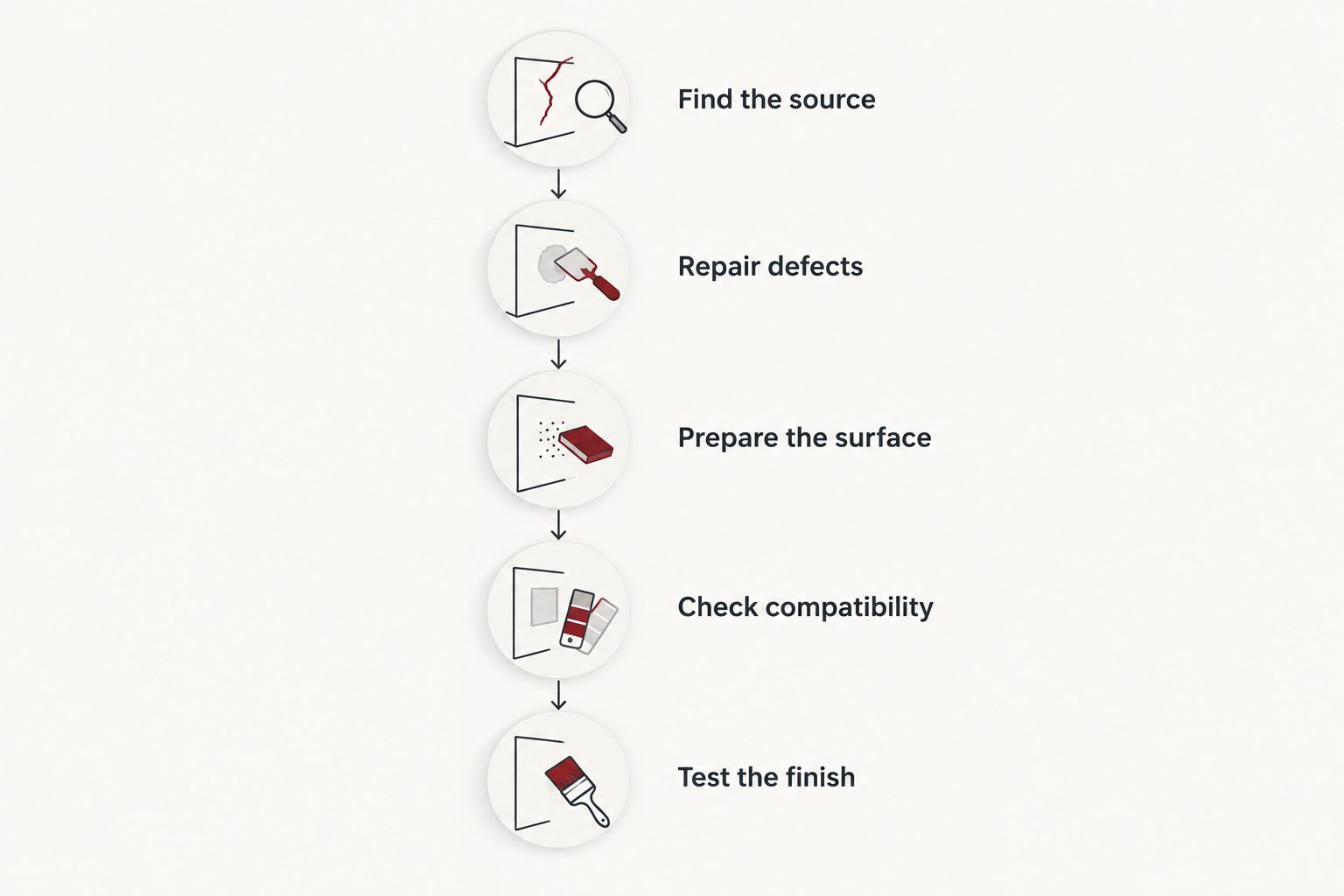
- Find the source. Inspect the damp patch alongside the terrace edge, parapet, window junctions and nearby plumbing. Record whether it appears after rain or remains during dry weather.
- Repair defects. Address leaking joints, damaged render and cracks with a repair method appropriate to the defect. Get recurring or widening cracks assessed before covering them.
- Prepare the surface. Remove loose material and deal with surface contamination according to the coating instructions. Painting over a weak layer does not strengthen it.
- Check compatibility. Confirm the repair, primer, waterproofing layer and finish as one proposed system. Follow the selected products’ application conditions.
- Test the finish. Apply a sample where practical, assess it after drying and approve the appearance before the full application.
Ask the painter to write down the chosen products and their layer order. That makes the proposal easier to check than a promise to apply waterproof paint.
How these options are ranked
This 2026 guide ranks categories by problem fit: direct rain exposure, sound-wall decoration, preparatory masonry treatment and preserving exposed masonry. The criteria are surface suitability, crack treatment, compatibility and the finish you need.
The ranking does not assign laboratory performance, lifespan or warranty comparisons to unnamed products. A suitable product used on the wrong problem is still the wrong choice.
Which exterior wall waterproofing option should you choose?
For a rendered wall exposed directly to rain, start with an elastomeric exterior wall coating whose instructions confirm the intended waterproofing use. For a sound wall that needs colour, choose an appropriate acrylic exterior emulsion instead of adding treatments without a diagnosed need.
Use a cementitious system when the repair specification calls for a separate masonry waterproofing base. Choose a clear repellent when retaining exposed masonry is the priority.
For your 2026 shortlist, use MRF Paints’ exterior wall paint and special-coating range as a starting point, then verify the exact product. Approve the repair and preparation plan before approving the paint.
FAQ
What is the best waterproofing paint for exterior walls in India?
For rain-exposed rendered walls, start with an elastomeric exterior wall coating explicitly approved for that use. The right choice still depends on the substrate, crack condition and source of moisture.
Is acrylic exterior paint enough to stop wall seepage?
Acrylic exterior paint alone is not a dependable answer to unresolved seepage. Repair the water-entry route and check whether the selected paint has documented waterproofing suitability.
Can waterproofing paint fix cracks in an outside wall?
Waterproofing paint cannot be assumed to repair cracks. Follow the product’s documented crack-treatment instructions, and have recurring or widening cracks assessed before coating.
Can I use terrace waterproofing paint on an exterior wall?
Use a terrace waterproofing product on a wall only if its instructions explicitly permit that application. Horizontal roofs and vertical walls have different exposure and finishing requirements.
Should I apply primer before exterior waterproofing paint?
Apply primer when the selected coating system requires it. The correct primer depends on the substrate, its condition and the layers being applied above it.
Can I paint exterior walls during the monsoon?
Paint only when the surface and forecast meet the selected product’s application conditions. Do not coat a rain-wet wall or assume that a brief dry spell satisfies the required drying window.
Does MRF Paints offer options for exterior walls?
MRF Paints offers exterior wall paints and special coatings. Confirm a named product’s intended substrates and waterproofing uses before selecting it for a damp exterior wall.
One last thing
Look above the stain before choosing paint for the stain. A damp patch below a window, terrace edge or parapet deserves an inspection of that junction first; repainting the visible mark is not the same as stopping water entry.
Related guides
- Waterproof paints for terraces and roofs
- Wall primers in India
- Damp-proof wall primers for monsoon-prone homes